Pravah : Harmonizing Water, Culture, and Environment

Author: Anish Shinde
Site Location: Poladpur, Maharashtra
Institute: Aditya College of Architecture
Advisor: Rita Nayak

Description

This thesis examines the vital relationship between water, human culture, and ecosystems, highlighting how water influences the identity, livelihood, and rituals of rural communities. Set in Poladpur, Maharashtra, a region with high rainfall yet chronic water scarcity, the project addresses the ecological and infrastructural failures behind this paradox.
In response, it proposes a multifunctional rural node that combines water infrastructure, rainwater harvesting, groundwater recharge, and runoff management with community-focused spaces for gathering, health, agriculture, and learning. Drawing from traditional systems like johads, kunds, and stepwells, the design blends indigenous knowledge with sustainable practices.
Rooted in field research and local engagement, the project also tackles outmigration, declining traditions, and the loss of communal spaces linked to water insecurity. Reimagining water as both a sacred resource and social connector, the design seeks to restore ecological balance, cultural pride, and community cohesion.
Crucially, the intervention creates a space for all villagers, wildlife, livestock, aquatic life, birds, and visitors, fostering a shared environment where water becomes the central unifying force, nurturing coexistence, biodiversity, and an inclusive rural future.

Drawings

Click here to go back to the storehouse.

Humanitarian Monastery

Author: Syeda Nabila Fatima
Site Location: Hyderabad
Institute: Poojya Dr. Shivakumar Swamiji School of Architecture
Advisor: Ar. Anju Wanti

Description

The Humanitarian Monastery is conceived as a place of peace, learning, and community that transcends religion and embraces universal human values. Planned across a 10-acre site, the design approach emphasizes harmony between people, nature, and the built environment. The site layout follows a flowing, circular, and oneness, and the rhythm of life. Each pathway, landscape, and structure emerges as part of a larger ecosystem, where movement feels natural and interconnected, much like the flow of water.
The project is structured around the idea of equitability through design. Public areas are positioned near the main approach for accessibility, while contemplative and private monastic spaces are placed deeper within the site to ensure tranquility. Curved roads, gardens, and water bodies create transitional zones that balance openness with seclusion. The contours of the land are integrated into the planning, allowing the landscape to guide placement and orientation of spaces, reducing intervention and enhancing sustainability.
This thesis is not just an architectural exploration but a humanitarian vision—where planning, landscape, and design techniques unite to create a sustainable, inclusive, and spiritual environment. It demonstrates how architecture can become a medium of healing, equity, and coexistence.

Drawings

Click here to go back to the storehouse.

Metamorphosis of Sonsoddo: Bridging the Gap Between Waste and Public Consciousness

Author: Muhammed Swaleh Beg
Site Location: Margao, Goa
Institute: Goa College of Architecture
Advisor: Dr. Uma Jadhav

Description

Metamorphosis of Sonsoddo – Bridging the Gap Between Waste and Public Consciousness reimagines the Sonsoddo landfill in Margao, Goa, as a catalyst for renewal rather than neglect. Once a peripheral site, now encroached upon by residences and schools, Sonsoddo symbolizes both environmental degradation and systemic failure in waste governance. This thesis proposes a transformative model that integrates waste management with public life, positioning the site as a shared urban resource.

The project critiques the prevailing linear “take-make-waste” economy and instead advances a circular approach, where discarded materials are reintegrated into productive cycles. Facilities such as upcycling workshops, training centers, an eco-market, awareness spaces, and landscaped trails transform the landfill into a place of learning, opportunity, and ecological restoration.

At its core, the proposal envisions a pilot ecosystem where enterprises, artisans, craftsmen, students, and the elderly work alongside each other, creating social, economic, and cultural value. Recyclable materials and RDF become resources for industry, while other materials are recycled, displayed, and repurposed, breaking down barriers between waste, knowledge, and community.

Through thoughtful site planning, sustainable infrastructure, and inclusive programming, the thesis positions Sonsoddo not as a symbol of exclusion but as a model for collective growth, resilience, and renewal.

Drawings

Click here to go back to the storehouse.

Building a Bridging Community: Re-imagining the Lives of the Sexworkers and Children of Sonagachi Redlight Area

Author: B Vishnu Priya
Site Location: Sonagachi, Kolkata
Institute: Department of Architecture and Planning, College of Engineering, Trivandrum
Advisor: Arun Cherian

Description

Going into Sonagachi and identifying the real issues inside is one of the most challenging tasks known to India. Over the years, It has formed impenetrable layers of security within itself making it difficult to leave once trapped inside. A sexworker’s  desire to escape from the cycle of prostitution, abuse and illness is overshadowed by fear and a lack of sufficient support systems.

This project aims to provide the sexworkers and children the freedom of choice by providing all required facilities to leave the profession and transition back into society as strong independent citizens. Once a sexworker has chosen to leave Sonagachi behind, this project welcomes them to join the process of reintegration.

The design program involves a newly curated administrative and architectural self-sustaining ecosystem to provide housing, opportunities for upskilling, assistance with child care and access to education, leisure and sense of belonging.

Exclusion can only be addressed by involving the public in the sustenance of this project. Hence the project forms 3 layers of privacy on site. The site level zoning forms a market area where the people of Howrah and Kolkata can freely move about. The second level stacks the housing of the women on top of the commercial zone creating a secondary street network exclusively accessible to the tenants. The third layer addresses the need for institutional facilities required for liberation.

The future of Sonagachi is not written in stigma, but in the strength of its women. A city that no longer defines them by the walls they were once confined within, but by the possibilities they are free to pursue. This project is a step toward an urban fabric that chooses inclusion over exclusion, dignity over neglect, and liberation over silence. In reimagining the lives of the women and children of Sonagachi, we are reminded that architecture is not just about structures—it is about lives, choices, and the collective courage to create change.

Drawings

Click here to go back to the storehouse.

Kasaykaar – A Journey From Ore to Finish

Author: Yashashree Pimple
Site Location: Near Aathawada Bazar, Teli Ali Ratnagiri
Institute: Aayojan School of Architecture and Design
Advisor: Ar. Divya Makhijani

Description

In the heart of Konkan, the rhythms of rituals, marketplaces, and seasonal festivals still echo through the streets—but the Tambat coppersmiths, once central to this living heritage, face quiet decline. Their tools are outdated, their knowledge undocumented, and their presence fading from the city’s evolving fabric. Rooted in the coastal town of Ratnagiri, Kasaykaar is a cultural center designed to revive the declining legacy of local coppersmiths—artisans whose knowledge, once central to the region’s economy and rituals, is now on the verge of disappearance due to lack of documentation, generational discontinuity, and limited adaptation to modern techniques. Despite high demand, most craftsmen struggle to meet market needs owing to outdated tools, absence of design innovation, and diminishing local recognition.
The center acts as a bridge—where tradition, technology, and equity converge. Equipped with shared workshops, material labs, and collaborative studios, it empowers artisans while engaging youth in reviving the craft through modern design tools and knowledge exchange.
It also celebrates the cultural richness of the Konkan region by creating a platform for endangered practices like Konkani Ranmus, supported by local activists striving to keep these traditions alive.
Strategically located between a temple and an active marketplace, the center integrates with its surroundings—offering shaded verandahs, transitional courtyards, and public thresholds that invite spontaneous engagement.
More than a building, Kasaykaar becomes an evolving identity—an inclusive space where artisans, locals, and visitors shape culture collectively, ensuring that heritage is not preserved in silence, but practiced through living participation.

Drawings

Click here to go back to the storehouse.

Building blocks of creative energy

The Tribune I Published on: August 17, 2025

Photo courtesy : Raghuveer Holla

An art institution is not merely a building made of bricks and mortar, but a living organism. It is not just a container of creativity, but a space that shapes the way we perceive, engage with and experience art. It holds within itself an atmosphere that is both material and immaterial — packed with potential and meaning.

Read the full article here Building Blocks of creative energy

False Ceiling Collapse at Goa’s Kala Academy Sparks Safety Concerns

OHeraldo I Published on: July 26, 2025

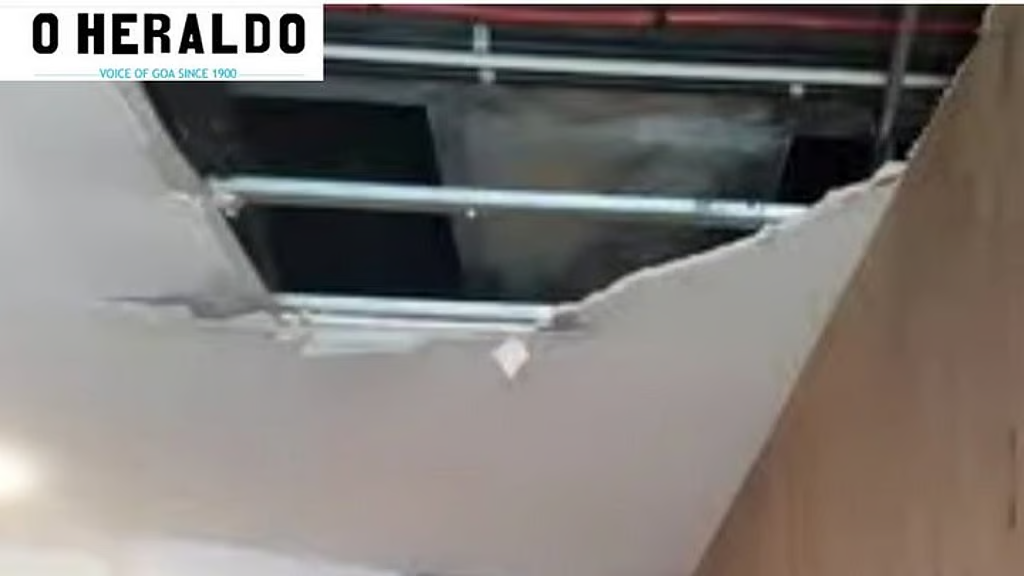
A section of the false ceiling in the Western Music classroom at Kala Academy, Goa, collapsed on July 26, 2025, raising serious concerns about the building’s structural safety. Fortunately, no injuries were reported. The incident occurred without warning, prompting academy officials to immediately cordon off the affected area as a precaution. Structural assessments and safety inspections are currently underway.

Read the full article here False Ceiling Collapse at Goa’s Kala Academy Sparks Safety Concerns

Kala Academy restoration: A betrayal of Correa’s vision

The Goan EverDay I Published on: July 20, 2025

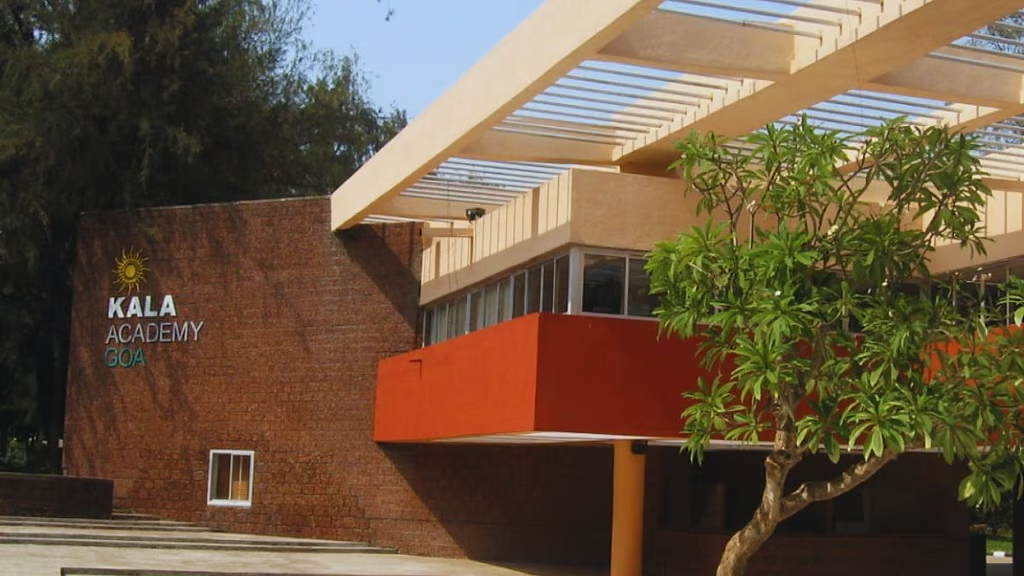
The Kala Academy in Panaji is a beautiful building that finds mention in architectural degree courses across India. It was a must-study building for us as part of the practical training tour at IIT Roorkee. Designed by the eminent Goan architect, the late Charles Correa, it is an iconic building of historical and cultural importance, being the only academy to offer a platform for western music, classical music, dance, drama, tiatr, folk art, photography exhibitions, book release functions, and literary events. 

Read the full article here Kala Academy restoration: A betrayal of Correa’s vision

Nagari 2025 Resource Experts

Kiran Keswani

Kiran Keswani is Co-founder, Everyday City Lab. She is an architect and urban designer based in Bangalore. She has completed her PhD in Urban Design from CEPT University, Ahmedabad. She has had an architectural & urban design practice for more than 20 years. She has taught courses at CEPT University in Ahmedabad and the Azim Premji University in Bangalore.

Parul Kumtha

Parul Kumtha is an architect, trustee of NAGAR and founder of Nature Nurture Architects and Planners. A graduate of Sir J.J. College of Architecture (1988), she has also studied Biodiversity Conservation and Built Heritage Conservation, and is trained in Mental Health and Narrative Practices. Her work focuses on resolving the often-conflicting relationships between architecture, heritage, and the environment. Her firm is empanelled as an Access Auditor under the Government of India’s Sugamya Bharat Abhiyan. She has previously served as visiting faculty at Sir J.J. College of Architecture, guiding dissertations and teaching courses on Urban Studies, Natural Heritage Conservation, and Universal Design. With NAGAR, she has worked extensively on public open spaces and accessibility issues in Mumbai.

Ashwini Deshpande

Ashwini Deshpande is an architect and urban researcher specialising in Architectural History and Theory from CEPT University. Her work bridges contemporary urban issues with historical inquiry, focusing on how planning, policy, and heritage intersect in shaping cities. She has previously worked as a Junior Archivist and teaching associate at CEPT University.

As Associate Director at NAGAR in Mumbai, Ashwini addresses civic issues related to public open spaces, heritage, slum rehabilitation, street vending, and land reclamation. She is also part of the Preserving Legacies cohort, a global initiative led by the National Geographic Society, ICOMOS, and the Climate Heritage Network, where she is representing Mumbai’s World Heritage Site of urban ensembles in efforts toward climate resilience and heritage preservation on behalf of NAGAR. Her research aims to critically examine how fragmented regulatory systems in cities across India produce environmental injustices and deepen social inequalities.

Avijit Mukul Kishore

Avijit Mukul Kishore is a filmmaker and cinematographer, working in documentary and interdisciplinary moving image practices. He’s involved in cinema pedagogy as a lecturer and curates film programmes for prominent national cultural institutions.

Shortlisted Entries 2025

Mauj ki Khoj (Seeking Fun)

In the small city of Bhuj, two young Muslim women, Sherbanu and Mariya, navigate societal and familial restrictions, carving out fleeting and risky moments of joy in the neighbourhood and city. Their friendship reveals how the public realm means constraints and freedom, where small defiant acts create space for Mauj.

Valai Pinnal

The fisherfolk of Nochikuppam navigate the shifting landscape of their homes in the wake of government interventions. Through myriad acts of preservation of materials, documents and oral knowledge, the film explores the people’s resistance and their relationship to space.

Through The Dappled Light

In Chandigarh’s rigidly planned city, trees offer shade and shelter to informal workers on the margins seeking space and belonging in a city that never planned for their presence. 

Fireflies in the Night

In a city where he’s used to being unseen, a trans man joins a midnight walk with queer strangers, where loitering becomes a quiet rebellion against identity erasure. On the other hand, as he rehearses his debut play ‘Beyond the Bodies’, he recollects his erasure and the moments of magic that a community brings.

Manaveeyam

‘Manaveeyam’ traces the life of a small urban street in Kerala’s capital city of Thiruvananthapuram, reclaimed by its people, where social inclusivity, civic responsibility and freedom converge, transforming into an accessible, socially just and inclusive public realm; a blueprint for the future.

Phool Gari (Scent of Nocturn Flowers)

This film aims to explore the quiet transformation of a liminal space beside Barasat railway station, from a morning auto stand to a night flower market and the resilient livelihoods that thrive within its rhythm.

Pascal Premier League

On a narrow street in Jogeshwari East, a group of young boys organise their own mini cricket league—reclaiming a congested public lane for play, joy, and community in a city starved of accessible open spaces.

Hissa

In the rapidly shrinking public spaces of South Bombay, two street barber brothers fight to preserve their dignity, legacy, and humble livelihood, operating on the edge of legality. As the city sanitises its image in the name of progress, we’re forced to ask: are we clearing mess, or erasing mobility?

महाद्वार

Mahadwar – The Great Corridor

Set against the backdrop of a ₹1445 crore redevelopment plan for Kolhapur’s Mahalaxmi Temple, the film explores the emotional and economic ecosystems of Mahadwar Road — a historic market street. Through voices of traders, vendors, and residents, it questions: can public memory survive without physical continuity?

Walls of Expression

Set in Mumbai’s ever-changing urban landscape, this documentary explores how public walls become sites of resistance, memory, and expression, while also revealing the fear, erasure, and control they provoke.

Pakdam Pakdai

In Agra, seemingly designed for cars, children invent playgrounds out of footpaths, medians, and market edges. Pakdam Pakdai scales the city to a child with a child’s eye view of play, resistance, and imagination—where joy collides with heat, traffic, and exclusion, and the city is both a game and a question.

Fragmented Realities

Fragmented Realities captures Kolkata during a time of unrest, where digital and real worlds overlap, revealing collective fear, protest, memory, and quiet hope within a shifting public landscape.

Cities & Ideologies: How Political Ideologies Shape The Public Spaces Of Indian Cities

“The city is a product of a state of war between political and economic forces that shape and re-shape the urban landscape.” – Mike Davis 1

Cities are often perceived as consequences of planning, geography and economy. We perpetually criticise our cities, in search of more inclusive spaces, but rarely do we acknowledge the powerful role of ‘political ideologies’ in shaping them. To substantiate this statement, we will take two contrasting cities – Kolkata (an old metropolis politically rooted in communist values) and Bengaluru (an emerging metropolis driven by neo-liberal growth), to depict how political worldviews manifest in the urban fabric.

The CPI(M)’s (Communist Party of India-Marxism-Leninism) thirty-two-year rule in Bengal created lasting impacts on the city’s core ideologies. A few of the positive core beliefs which people of Kolkata grew into were ‘sensitivity towards class issues’, ‘preaching for equality’, and ‘active civic participation’. On the other hand, Bengaluru’s neo-liberal transformation started with Sir M. Visvesvaraya’s address to the Bangalore Literary Union in 1953, where he said:

“What makes Americans long-lived, progressive and prosperous”, he continued, “is the planned, disciplined lives they lead. Our activities on the other hand are unplanned, and our behaviour unplanned and inactive.” 2

This comparative statement, along with his appeal to the citizens to see themselves as ‘stockholders of the city corporation’ 3 in every municipal engagement, sowed the seeds of the present neo-liberal growth of Bengaluru, inspired by the West.

The Left Front in Kolkata actively resisted the privatisation of urban land, enabling the survival of expansive green spaces like the Maidan, accessible at all times. Its porous edges were a result of ‘proletarian power’, dismantling boundaries and ensuring equal spaces for all. 

In contrast, Bengaluru experienced a surge of rapid, unregulated urbanisation, unlike Kolkata’s slow-paced growth. To manage this, the city adopted quick fixes which included – gated parks, walled/fenced green spaces and controlled access points with regulated timings and activities.

Left Photo Credit: S. K. Dinesh Lalbagh’s Boundary Wall- Non-porous and greenery unseen to the public

Right Photo Credit: Google Earth

Urbanisation brings unique challenges for the city’s residents. In response, residents engage, express, and reclaim space to shape and survive the city. Thus, protest becomes a huge outlet for people in voicing and asserting their rights. Protest needs to be witnessed so that every citizen can comprehend and hold hands in the process of justice. 

The strong Marxist-Leninist influence is the sole reason why protest is inscribed into Kolkata’s urban fabric. Protest and dissent is viewed as a ‘civic responsibility’.The R.G Kar Protest stands as a testament to this city-wide procession for women’s rights, driven not by propaganda but by a shared sense of justice.

On the other hand, Bengaluru’s Town Hall, once home to powerful public gatherings echoing with resistance songs, has moved towards restraining dissent. After the city-wide protest of Anganwadi Workers and Devanhalli Farmers 4, the Bengaluru Police Commissioner issued an order strictly containing all protests at Freedom Park, in a designated parking lot far from the public sight. Outside this zone, protest is classified as ‘civil disobedience’, drawing swift police response. Shaped by the priorities of neo-liberal governance, a city once with a vibrant political voice now struggles with a silenced public sphere.

Left Photo Credit: Bhanu S Citizens of Bengaluru protesting against confining protests to Freedom Park

Right Photo Credit: The Hindu R.G Kar ‘Reclaim the Night’ city-wide protests for women’s safety and rights

Though a riverine city, Kolkata never initially prioritised greenery due to its early urbanisation. Instead, its communist egalitarianism helped make the old streets the citizens’ ‘third space’ 5. Every space available in the exterior capable of holding people (footpath, steps of an old house, underneath a flyover, etc) becomes a place of social exchange. In Correa’s words:

“They have raised disintegration to the level of high art.” 6

The larger question which currently arises is: To what extent can you romanticise the past? This is the dilemma Kolkata is facing in shaping its public spaces for future generations. Spaces once celebrated require thoughtful revival.

In contrast, Bengaluru has been the ‘City of Lakes’ adorned with greenery, formed by encompassing two hundred villages, whose reminiscence is still present in its place names ending with ‘halli’ (village in Kannada, eg., Marathahalli, Baiyyapanahalli, etc). The rapid shift from a low-rise settlement to a high-density urban sprawl, along with the diminishing greens and lakes, makes the future of free public spaces extremely uncertain.

Left Photo Credit: X/@sahana_srik Bizarre restrictions in Public Parks of Bengaluru

Right Photo Credit: Sanat Kr Sinha Hawkers occupy the entire stretch of the footpath – no pedestrian pathways in College Street, Kolkata

A shift in political ideology exposes huge vulnerabilities in its civic spaces. The ongoing tension of the Left versus Right creates a state of duality with disjointed experiences in the city of Kolkata. Whereas, unchecked rapid neo-liberal expansion is eroding equity in Bengaluru’s public spaces.

Thus, the design of our cities cannot remain apolitical. Political indulgences are necessary to create rooted spaces which are inclusive, honouring the past, responding to the present, and accommodating the future of our cities.

– Written by Anwesha Saha, Research Fellow

Footnotes:

  1. Davis, Mike. City of Quartz. 1990. ↩︎
  2. Nair, Janaki. The Promise of the Metropolis. 2005. Pg-14 ↩︎
  3. Nair, Janaki. The Promise of the Metropolis. 2005. Pg-14 ↩︎
  4. Bangalore Mirror:
    https://bangaloremirror.indiatimes.com/bangalore/others/karnataka-anganwadi-workers-demand-wage-hike-and-job-recognition-amid-protests/articleshow/118227037.cms

    The Hindu:
    https://www.thehindu.com/news/national/karnataka/leave-us-and-our-land-alone-why-devanahalli-farmers-have-been-protesting-for-over-1180-days-against-karnataka-government/article69743773.ece ↩︎
  5. Homi K. Bhaba ↩︎
  6. Correa, Charles. The Times of India. Oh Calcutta. Bombay, 1975. ↩︎

City on the Water – Density, Growth and Development

“Half a million people arriving every morning … nobody leaving” 

With this line, Charles Correa’s film, ‘City on the Water’1, sets the stage for a city that is reaching its limits and builds a case for its solution. Correa made this film exactly 50 years ago, in 1975, as part of a larger effort to bring out the urgent need for expansion to the city’s authorities. The proposal was for a new city across the harbour, designed to relieve the intense pressure on Mumbai, to be called Navi Mumbai. But the questions the film highlights go far beyond the proposal. How long can a city keep absorbing people without confronting who has the right to the land resource and dignity? 

The aerial shots present throughout the films show a city squeezed between water and demand. Correa points out that the real edges of the city are not drawn by nature, they are drawn by policy, power and money. Mumbai or Bombay in the 60s, was the ‘nerve centre of the Indian economy’, an attraction point for new technology for India, generating nearly half of the entire revenue of the government of India.

A city born out of migration, Bombay’s growth showed no signs of slowing down. As a city, Bombay was a place where, every day, tens of thousands arrived with hopes in their pockets, only to find that the city was both generous and cruel, a contrast that is represented through the film. This brings forth important questions: Are our cities physically capable of absorbing endless demand? Or are we merely redistributing scarcity by squeezing more people into less space, eroding both the environment and the quality of life? A recurring image in the film shows trains spilling out waves of people into the city. These are not just commuters; many are migrants searching for work, shelter and survival. Where does this endless tide of people live?

Result of an overcrowded city with people occupying the streets and pavements.

The camera moves towards the overcrowded pavements, congested chawls, and temporary shelters folded into the city’s cracks and margins. Through this, Correa questions “what is worse, the temporary slums or the permanent ones?” This wasn’t just about Bombay. This is yet the defining crisis of every rapidly urbanising city today. 

Long after Navi Mumbai has been built, the core tensions that he outlines – between migration and exclusion, between geography and inequality – still remain unresolved. One of the film’s sharpest insights is how building heights are directly linked to land prices. As land gets scarcer, buildings grow taller, and rather than solving the problem, this ends up raising the price of the land. To address this, he proposed to add more land to the residential pool by decentralising Bombay and expanding to New Bombay.

Graphical representation for the expansion of residential areas by showing two cases: increasing building height vs increasing land area.

Land in the city is not neutral. It is hoarded, speculated on and made into a commodity. It makes it less about living on it and more about trading, leverage and wealth expansion. The URDPFI (Urban and Regional Development Plans Formulation and Implementation) has set a target of 10 to 12 sqm of open space per person in India. However, according to the survey conducted by Project Mumbai in 2021, Mumbai currently has 1 sqm of open space per person2 3. Planning decisions about zoning, density and infrastructure are not just technical; they are deeply political acts that determine who gets to belong and who gets pushed to the edge. Are we building cities for people, or as a commodity? In his book, “The New Landscape”, Correa argues that failure is not technical; it is political4. When more than half of the city’s population lives without formal access to land, basic services, or security, can we still call it a “good” city? 

Behind the words “density,” “growth,” and “development” are real and lived experiences of the people. When a city can not offer any more shelter, it does not stop people from migrating to the city; it redistributes them into scarcity. A child growing up on the pavement, a family living in a one-room rental without water or light, and workers commuting 3 hours each way just because the city does not have space to accommodate people near their workspaces. These are not normal circumstances, even if we have learned to cope with them. It is just part of a system that accepts exclusion as a byproduct of urban success. If survival itself becomes the primary occupation of so many, what does it even mean for a city to be “functional”?

Rough proposal plan for New Bombay.

City on the Water leaves us with the thought that cities will continue to grow. But the growth itself is not the crisis. The crisis lies in whether that growth is inclusive or whether it survives by pushing more people into the margins. When a city floats between hope and neglect, whose responsibility is it to keep it from drowning?

To watch the film, click here.

– Written by Dainty Doe Justin, Fellow

Footnotes:

  1. Correa, C. M. (Director). (1975). A City on the Water [Film]. Film Division. ↩︎
  2. Virani, S. (2021, November 17). Mumbai has less green than what masterplan shows: just 1 sq m per person. Citizen Matters. ↩︎
  3. Gokarn, S. (2024, May 31). Pockets of greenery and recreation: How Mumbai is claiming its open spaces. Citizen Matters. ↩︎
  4.  Correa, Great City … Terrible Place from The New Landscape, pg 86 ↩︎

Australian architect Peter Stutchbury delivers keynote at eighth Charles Correa Memorial Lecture in Kolkata

NorthEast Herald I Published on: July 3, 2025

This year’s keynote was delivered by the Australian architect Peter Stutchbury, who is known for his environmentally responsive design philosophy. In his address, Stutchbury paid tribute to Correa’s influence on not just him but many around the world, describing him as a “philosopher of space”.

“It’s an immense honour to deliver the 8th Charles Correa Memorial Lecture in the very city where a part of his extraordinary vision came to life,” said Stutchbury. “Charles Correa was not merely an architect; he was a philosopher of space…”

Read the full article here Australian architect Peter Stutchbury delivers keynote at eighth Charles Correa Memorial Lecture in Kolkata

Unspoken Agreements

“The street is a room of agreement.” 1 Kahn’s quip at his AIA Gold Medal acceptance speech holds as true today as it did in 1971. 

The quintessential Indian street is methodical madness personified. Heisenberg’s (1927)  ‘Atomic Uncertainty Principle’ largely extends, in hypothesis, to the moving elements of the streetscape – we cannot accurately predict, at any one given moment in time, its exact nature. The street itself is occupied and claimed by numerous other independent actors and self-made processes.2


Unlike the European street model with crystal cut demarcations for motorists, cyclists, pedestrians, HMVs, etc., the Indian street also accounts for variables that cannot be monitored so closely. Livestock, street performers, street vendors, rickshaws, automobiles, pedestrians, and the like, all exist in harmonious disarray, moving at mismatched paces. Their coordination is unpractised and indeterminate, yet unanimous and accommodating.

 “….there is nothing simple about that order itself, or the bewildering number of components that go into it. Most of those components are specialized in one way or another. They unite in their joint effect upon the sidewalk, which is not specialized in the least. That is its strength.” 3 

Herein lies the unspoken agreements of the spaces they intend to occupy to perform their individual process. In this context it’s important to recognise that rules need not be written, nor do they result from formal legal procedures (with respect to informal interactions and space usage).4 When you enter a street, you are inevitably a part of this agreement. Fractional decisions – to swerve, to avoid, to give way, or to participate, exist in the background, and the result of these instantaneous decisions, culminate in the foreground. 

The entropy of this “room of agreement” can also be observed over a larger timeline. For instance, over the course of a year, the Indian street transforms from a place of congregation, to annual festival celebrations, mourning, religious processions, etc., on a cyclical timeline. 

Man in any civilization, age old, has been either actively or passively contesting for space with his neighbor. Streets are not “public goods” but “rivalrous goods.” Everyone is competing for their own space. This has transformed the Indian street into spatial slices with multiple users at any given moment in time.

How do we account for these known unknowns? The very concept is a paradox! Do we consider these minute interactions on the drawing board when we plan our cities, structure our roads and build our private homes? Are you able to recognise the unspoken agreements that you are a part of?

– Written by Ankritya Diggavi, Research Fellow

Footnotes:

  1. Kahn, 1971 ↩︎
  2. Palgrave handbook of Bottom-up urbanism – Arefi and Kickert ↩︎
  3. The Death and Life of Great American Cities – Jane Jacobs, 1961 ↩︎
  4. Angela Jain and Massimo Moraglio, 2014 ↩︎

Public and Private in a Heritage precinct

Fontainhas, Goa

Fontainhas is a unique case where boundaries between private and public are blurred due to various spatial and social factors. Accredited as a UNESCO Heritage Zone in 1984, the area is known for its colourful Indo-Portuguese houses, narrow lanes, and pedestrian-friendly scale that evoke a ‘slice of European charm in India’. Fontainhas’ charm lies not only in its architectural quality but also in its scale and rhythm of everyday life. What used to be a quaint residential area with 4-5 tourists strolling reflectively is now crowded with 25-40 people at once. Tourists have increased significantly in recent years, transforming the everyday spatial interactions of the area. This contrast of everyday lived-in experience with a curated heritage image for tourism is transforming the area’s public and private boundaries. 

Whether privately or publicly owned, spaces tied to heritage hold public significance, but scholars such as Kohn (2004) and Madanipour (2003) challenge this rigid binary of public and private space, suggesting instead a spectrum, where quasi-public spaces emerge1. This is defined as a privately owned area that is designed and managed to function like a public space. Streets and pathways are open and publicly accessible, yet deeply embedded in the private lives of residents. The hidden layers – stepped pathways, sloping alleys, and informal routes known only to residents add to the space’s charm. Small hawkers selling fruits and ice cream crowd the touristy lanes as residents walk to their everyday tasks. This shared use adds to the complexity of the space. According to MoHUA, in a heritage precinct, the legal status of private property can be transformed by designation, effectively making private spaces accessible to the public or subject to public oversight and regulations2

Tourists in Fontainhas do not engage with private homes directly but through visual means by photographing thresholds and facades, and spatially by loitering outside Balcãos and doorways. The ‘public’ and ‘private’ here become extremely hard to define, but at its core, it’s different user groups’ demand for inclusion in the same space. It becomes necessary to regulate heritage areas towards harmonious and sustainable development3. What is everyday spatial interaction for residents becomes a tourist attraction through its shared but distinct use, transforming private facades into public spectacles. The everyday practices of some residents, like maintaining outdoor gardens and pathways, become an integral part that adds to the publicness of the area. While the public enjoys the aesthetic of the space, the burden of upkeep and inconveniences, such as blocked roads or loss of privacy, falls solely on residents. No incentives are provided to the owners of the heritage houses for maintenance and repairs4. This poses a larger question of who benefits from the heritage. If private spaces are put to public use without public rights and freedom, is it still a public space?

As heritage increasingly narrows its focus on tourism, space risks being frozen in time. This raises critical questions: Who is this heritage for? How does heritage blur the boundary between public and private spaces? The case of Fontainhas highlights the complex interplay of public and private realms. As urban heritage continues to expand, the balance between preservation, public enjoyment, and private life demands thoughtful governance. One that responds both to the rights of residents while acknowledging the cultural value these spaces offer to the wider public. What we need is people-first, adaptive heritage thinking5. We must advocate against freezing places in time. This means recognising that heritage values and contemporary needs are not in conflict, and in the blurring of public and private, it’s the people who make the space. 

– Written by Ashmita Gupta, Senior Fellow

Footnotes:

  1.  Li, Juan, et al. “Defining the Ideal Public Space: A Perspective from the Publicness.” Journal of Urban Management, vol. 11, no. 4, Sept. 2022, https://doi.org/10.1016/j.jum.2022.08.005. ↩︎
  2.  Chapter-8 Conservation of heritage sites including heritage buildings, heritage precincts and natural feature areas. ↩︎
  3.  Conservation of Heritage Areas in the City of Panaji: A Case Study of Fontainhas Area by Shaikh Ali Ahmed, Dr. B. Shankar, IJMER, vol. 2, no. 2, Apr 2012 pp-442-446 
    ↩︎
  4.  The Goa (Regulation of Land Development and Building Construction) Act, and The Goa Land Development and Building Construction Regulation, 2010 
    ↩︎
  5.  Conservation and the Indian city: Bridging the Gap, edited by Poonam V. Mascarenhas & Vinayak Bharne
    ↩︎

India’s cities are collapsing — why Gen Z must rediscover Charles Correa’s forgotten blueprint

The Telegraph India I Published on: June 29, 2025

Charles Correa

It’s been 10 years since Charles Correa’s passing in 2015, but his relevance in today’s urban debates has only grown stronger. At a time when Indian cities are buckling under unplanned development and the effects of climate change, Correa’s work and writing offer a counterpoint — one that privileges human-scaled, and environmentally responsive architecture.

Read the full article here India’s cities are collapsing — why Gen Z must rediscover Charles Correa’s forgotten blueprint

When politics takes the stage, art pays the price

Goemkarponn I Published on: June 23, 2025

Should only artists head institutions like Kala Academy and Ravindra Bhavan? It’s a question that resurfaces every few years in Goa, often sparked by controversy, corruption, or sheer frustration from the artistic community.

Read the full article here When politics takes the stage, art pays the price

Ten years since Charles Correa’s passing, his buildings remind us that he was ahead of his time

Scroll.in I Published on: June 16, 2025

Image credits : Scroll.in | The famed architect’s work revealed a deep understanding of space as traditionally built and used in India.

It is ten years since architect Charles Correa passed away on June 16, 2015, at the age of 84.

The day after he died, The Indian Express carried a front page photograph of the Champalimaud Centre for the Unknown, a major medical and research institute in Lisbon. Although this iconic building was designed by Correa, the article was not a recognition of his passing.

Read the full article here Ten years since Charles Correa’s passing, his buildings remind us that he was ahead of his time.

Shab-Parak: Night fliers of Delhi bus that’s a community

Question of cities I Published on: May 30, 2025

Image credits : Shab-Parak, Nagari Short Films 2024

As India’s national capital sleeps, night buses keep the city connected and their commuters find the true meaning of accessible and affordable public transport. Shab-Parak, a short film which won the silver at the Nagari 2024 awards, captures the story of Delhi Transport Corporation’s Bus 0543A from Anand Vihar Inter State Bus Terminal to Kapashera border, its tired but pleasant driver who commands his bus like a community, and its commuters many of whom are at their workplaces as the city awakens.

View the short film here and read the full article here : Shab-Parak: Night fliers of Delhi bus that’s a community

Know what is ‘Supari Andolan’ to save Goa’s Kala Academy

Gomantak Times I Published on: May 24, 2025

Image credits : Gomantak Times | ART OF THE MATTER : Goa’s Kala Academy is in they eye of the storm following a controversial remark by Goa’s Art and Culture Minister

‘Supari Andolan’ is a creative protest by Goan artists reclaiming a slur to defend the iconic Kala Academy and preserve Charles Correa’s legacy, demanding accountability, transparency and cultural respect.

Read the full article here Know what is ‘Supari Andolan’ to save Goa’s Kala Academy