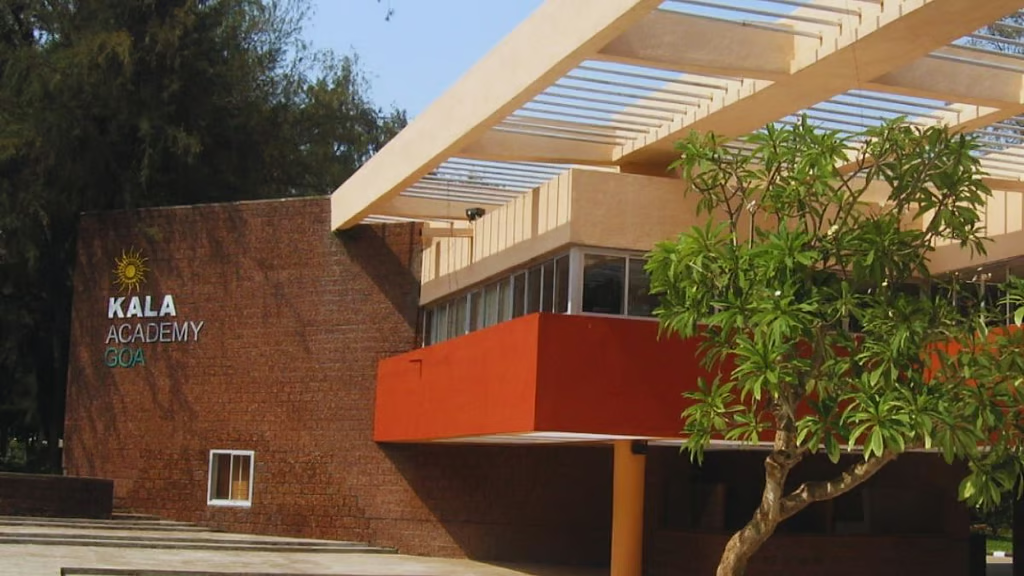
Image credits : Gomantak Times | ART OF THE MATTER : Goa’s Kala Academy is in they eye of the storm following a controversial remark by Goa’s Art and Culture Minister
‘Supari Andolan’ is a creative protest by Goan artists reclaiming a slur to defend the iconic Kala Academy and preserve Charles Correa’s legacy, demanding accountability, transparency and cultural respect.
Q. Is it mandatory to have an architect, urban designer or a social scientist in the team?
No, it’s not required, but we strongly encourage it. Including an architect, urban planner, or social scientist can greatly enrich your project’s narrative and depth. You’re welcome to apply with your existing team, and you’ll have the flexibility to add members later if needed.
Q. Can beginners/film students apply for the competition? Asking this as the form states that one of the participants has to be an experienced filmmaker.
Yes, film students and amateur filmmakers are welcome to apply. If you check the form it mentions “prior filmmaking experience”, we have permitted entries from amateur filmmakers and film students, provided they have some experience in shooting, editing and producing film.
Q. Would we have to pay or spend from our side? If yes, then how much would that be?
Nagari provides a grant of 75,000 to each selected team. The management of costs under or beyond this grant is the responsibility of the team.
Q. How many ideas can one team apply for?
Each team is encouraged to submit only one idea. If you have more than one concept, you may submit them as separate entries.
Q. Is there a suggested or ideal number of collaborators?
It’s ideal to have one primary contact person to streamline communication and logistics. We recommend 2–3 collaborators per team. Additional team members can be brought in as needed throughout the process.
Please feel free to post your queries in the comments section below or mail us at nagari@charlescorreafoundation.org.
The once regal Kala Academy, which has hosted many a celebrity and has been the venue of numerous big-ticket events, including the international Film festival of India, has now been reduced to a joke, or rather, a comedy of (contractual) errors.
Just days after the media reported that Kala Academy was likely to be closed for two whole months for ‘rectification’ work, the state government was slammed for continuing to delay the upgrade of the iconic centre of the arts. But what probably evoked widespread public ire was chief minister Pramod Sawant recently saying that the current contractor will complete repairing the rectifications themselves at no additional cost, in keeping with the Kala Academy’s task force suggestion, and complete the work by October this year, in time for IFFI. “Once that is done, the contract will be terminated and the contractor will be blacklisted,” Sawant is reported to have told the media. If this was not enough to enrage citizens, Sawant went a step further by blatantly declaring that new tenders will be floated for additional works that were not covered in the original contract.
The Goa government has blacklisted contractor Techton Buildcon Pvt Ltd due to renovation flaws at the iconic Kala Academy. Critics, including political opposition and artists, raised concerns about light and sound issues. The government canceled the contractor’s annual maintenance contract and a task force will implement remedial recommendations.
The Goa government has taken decisive action by blacklisting Techton Buildcon Pvt Ltd, the contractor responsible for renovating the iconic Kala Academy. This decision follows persistent flaws in the renovation work, which have drawn widespread criticism from opposition parties and local artists.
Chief Minister Pramod Sawant announced that the contractor has until October to rectify these issues at their own expense. Furthermore, plans for a four-year annual maintenance contract with the contractor have been canceled. The decision came in response to disruptions experienced at the 1,000-seat Deenanath Mangeshkar auditorium, including light and sound problems.
The Goa government on Friday said a contractor had been blacklisted for flaws in the renovation of the iconic Kala Academy building here. Chief Minister Pramod Sawant said contractor Techton Buildcon Pvt Ltd has been given time till October this year to rectify the flaws at its own cost. The government has also cancelled a proposal to sign a four-year annual maintenance contract (AMC) with the contractor, Sawant told reporters. The BJP government in the state had come in for criticism from opposition parties and artistes after glitches were observed in the newly-renovated Kala Academy complex, including light and sound disruptions at the 1000-seater Deenanath Mangeshkar auditorium.
The task force constituted to assess and recommend improvements for the Kala Academy’s infrastructure has submitted its final report to Chief Minister Dr. Pramod Sawant. A meeting with the Public Works Department (PWD) and other relevant authorities to review the findings is scheduled for Friday, May 9, 2025.
Speaking at Mantralaya in Porvorim on Thursday, CM Sawant confirmed the submission. “The Task Force on Kala Academy has submitted its report today. I will hold a meeting on this tomorrow. I haven’t gone through the report yet,” he told reporters.
The task force, chaired by renowned theatre artist Vijai Kenkre, was formed in response to mounting concerns from Goa’s arts community, who criticised the ongoing renovation work at the state’s premier cultural complex as haphazard and unstructured, despite substantial expenditure.
NAGARI 2025 aims to capture the essence of public spaces in Indian cities. Public space is defined as places that are open and accessible to everyone – this usually includes maidans, gardens, waterfronts, etc. The Indian city often broadens this definition of public space, due to its high density, to include streets, footpaths, markets, alleyways, transport infrastructure, among others. Thus our public spaces are layered by use, scale and activity, varying across days, seasons, groups, and movements. This is the public realm. It is “where a city’s culture is expressed most freely and openly, and it is where the city is at its most democratic, honest, and energetic” (Martin, 2017).
Keeping public space as the central focus, Nagari will examine the complex interactions between people from different castes, classes, age, and gender, as well as address an important question – What are the layers that constitute the public realm in urban India?
Nagari 2025 attempts to address:
-Livelihoods in public spaces -Informal use in public spaces -Making the public, private -Civic engagements in public spaces -Public spaces at night -Transient public spaces -Barrier free public space -Gendering in public space -Social accessibility in public space
Applications for Nagari 2025 are now closed!
Public Realm in Urban India
Click on the image above to learn more about the final films
Click on the image above to learn more about the shortlisted entries
Whether privately or publicly owned, spaces tied to heritage hold public significance. Fontainhas becomes a unique case where boundaries between private and public are blurred due to various spatial and social factors.
Cities are often perceived as consequences of planning, geography and economy. We perpetually criticise our cities, in search of more inclusive spaces but rarely do we acknowledge the powerful role of ‘political ideologies’ in shaping them.
Deepa’s documentaries and writing that span a period of forty years, engage with questions related to women’s status, political participation and resistance. Her films have been screened and awarded at national and international film festivals, and she has also served on the Jury at National and International film festivals.
Pankaj Rishi Kumar
After graduating from FTII Pune, India, in 1992, with a specialisation in Film Editing, Pankaj was assistant editor on Sekhar Kapur’s ‘Bandit Queen’. He made his first film ‘Kumar Talkies’ in 1998. Pankaj has become a one-man crew- producing, directing, shooting and editing his own films under the banner of Kumar Talkies. His films have been screened at film festivals all over the world. Pankaj also curates and teaches.
Jabeen Merchant
Jabeen Merchant is a film editor trained at the FTII Pune, with a wide experience in the mainstream industry as well as independent, art house cinema. She also teaches filmmaking and consults on scripts. Her work, which includes fiction features, documentaries, web series and short films, has been seen in countries across the world, in festivals and movie halls.
Bina Paul
Bina works mainly in Malayalam-language films. She has over fifty editing credits. Bina won her first National Film Award for Revathi’s ‘Mitr, My Friend’, which had an all-woman crew. She has been the artistic director of the International Film Festival of Kerala and in 2017 she was appointed as one of the heads of “Women Collective in Cinema”.
Sourav Sarangi
Sourav Sarangi is an award-winning film maker from India. He put down his geologist’s hammer to pick up a camera and tell stories. Stories that entertained and informed us, stories that transformed our views. His journey began from Kanthi, a small town in South Bengal, to become a fellow of the Film Independent, LA, in collaboration with The U.S. Department of State’s Bureau of Educational and Cultural Affairs. National and international film festivals in Berlin, Sydney, Dubai, Locarno, Nyon, Yamagata, Guangzhou, Moscow, Goa, Thessaloniki, Busan, Toronto and many more have premiered and awarded his films. Broadcasters and academic institutions found him a large global audience. “I don’t follow stories, they live in me,” says Sourav.
Rajula Shah
Rajula completed her diploma in Film Direction from FTII, Pune. She holds a masters degree in English Literature. She has been producing/ directing short films since 2000; has worked extensively in film and video, exploring the boundaries of fiction/ non-fiction, photography, video essay, & New Media Practice.
Delegation demands minister’s resignation over recurring technical failures and derogatory remarks
In a scathing attack on the State government, a delegation comprising Congress leaders and artistes visited the Kala Academy on Sunday, questioning the authorities over the recurring technical failures at Goa’s premier cultural institution and calling for the resignation of Art and Culture Minister Govind Gaude.
The delegation also demanded that Minister Gaude publicly apologise to veteran actor Sharad Ponkshe and the wider artistic community for derogatorily labelling Ponkshe a ‘Suparibaaz’ following the disruption of his performance last week due to lighting issues at the Academy.
They further claimed that the renovation of the iconic institution—designed by renowned architect Charles Correa—had tarnished Goa’s reputation in the cultural domain.
The Charles Correa Foundation (CCF) announces the 2025-2026 cycle of the Research Fellowship, a residency program based in Fontainhas, Panaji, Goa.
Apply by 10 May 2025 for a year-long position opening June 2025 with the following qualifications:
Proficiency in using the following software – InDesign, Photoshop, Illustrator, AutoCad + SketchUp.
Academic Architectural Portfolio.
Essay – 500 words (max). Choose any one of the following prompts:
Illustrate how any one of Correa’s mid-20th century built structures influenced subsequent proliferation of similar typologies, and how they affected the urban public dynamic of a city.
“Cities are not just buildings and streets. A city is also about events, people, communities and spaces for synergy where people can meet. To register protest. To celebrate. It is synergy that makes a city come to life.” – Correa, The New Indian Express, Dec 1st, 2014. Referencing this excerpt, take any one of his built structures as an example and illustrate how it fosters kinship in the urbanscape.
Writing sample – from an earlier academic paper.
During the Fellowship, you will be required to:
Work on the documentation of drawings and photographs of Charles Correa’s built and unbuilt projects, sketches and essays.
Reference archival material to redraft drawings for publications/exhibitions. Assist in creatively designing and scheduling of the events related to the activities of the Foundation.
Organise and work on outreach programs of the Foundation through publications, conferences, exhibitions and workshops.
Assist in work related to acquiring funding for projects or events related to the activities of the Foundation such as preparation of dockets, posters, invitations, etc. Work on writing up about concerns and issues related to architecture and urbanism, and represent them through essays, blogs, etc.
Creatively communicate outputs and learnings from past and on-going projects to increase the Foundation’s engagement across various social media platforms and our website.
Make presentations on the Charles Correa Archives, on his philosophy and works, to keen visitors coming to the Foundation, ranging from travellers, student groups and professionals.
Assist in preparation of project proposals, surveys and documentation, mapping and analysis, graphics, essays and presentations related to the research project, including coordination with agencies (government or private) for permissions, status, fees, etc.
Fellows will receive a monthly stipend of ₹22,000/- as well as rent-free accommodation in an apartment leased by the Foundation.
Minister Govind Gaude blames ‘technical glitch’, not human error
Even after a Rs 50 crore renovation, the Kala Academy — Goa’s premier cultural venue — is facing basic operational failures, with no one willing to take responsibility. The recent light malfunction during a Marathi play has exposed not only technical flaws but also the absence of accountability among the agencies involved.
Art and Culture Minister Govind Gaude on Thursday termed the incident — where stage lights flickered and halted the performance for 10 minutes — as “unfortunate,” but was quick to dismiss it as a technical fault rather than human error.
Here’s a look at how poor planning and botched renovations have plagued Goa’s premier arts institution for over half a century
February 28, 1970 – Goa govt establishes Kala Academy to promote the arts. The iconic building is designed by renowned architect Charles Correa
2004 – Upgraded to serve as a venue for International Film Festival of India
October 30, 2017 – Minister Govind Gaude announces major facelift for Kala Academy
May 23, 2021 – Techton Buildcon Pvt. Ltd. awarded contract for renovation work. Performances come to a standstill
July 17, 2023 – A large portion of open-air auditorium collapses, raising safety concerns
November 10, 2023 – Building reopens after repairs, but concerns about construction quality persist
April 22, 2024 – Part of newly-renovated false ceiling crashes due to water leakage
May 20, 2024 – Heavy downpour causes auditorium roof to leak during a performance of the Konkani tiatr ‘Girgirem’
July 8, 2024 – Heavy rains inundate Kala Academy
September 27, 2024 – State govt forms task force led by theatre artist Vijai Kenkre to assess state of building and recommend improvements
October 25, 2024 – Charles Correa Foundation withdraws from offering assistance, citing lack of structural audit
April 13, 2025 – Technical failure in stage lighting causes temporary stoppage of a Marathi play starring Sharad Ponkshe, who apologises to audience
The famed Kala Academy has faced several ignominious setbacks, including flooding from a roof collapse during rains and the partial collapse of its open-air auditorium.
The Charles Correa Gold Medal is an award initiated in 1998 by Indian architect and urbanist Charles Correa. Through the format of the Gold Medal, the Charles Correa Foundation intends to not only challenge students and schools of architecture to focus on pressing issues, but also to emphasize the role that architects can play in society as “agents of change”.
For the next 3 years, the Charles Correa Gold Medal will focus on thesis projects that address ‘Equitability through Design’. By raising the question, ‘Who are we designing for?’ the Gold Medal seeks to reflect on the opportunities and responsibilities that we as architects have in creating spaces that are equitable and inclusive. This encompasses equal access to space, shelter, infrastructure and the commons.
The thesis projects will be evaluated in terms of how they address current spatial injustices through design, and how they approach equity and inclusion at different scales.
This year, the Gold Medal will be awarded along with a cash prize of ₹25,000.
Join us for the Charles Correa Gold Medal Award Ceremony 2025! The proceedings feature three events – the book launch of ‘Designing Equitable Cities’ (proceedings of the Z-axis 2018 Conference), a talk by Samir D’Monte, the Principal Architect of SDM Architects, Mumbai, and a discussion with the jury members on this year’s theme, ‘Equitability Through Design’.
Date: Tuesday, September 16, 2025
Time: 06:00 to 08:00 pm IST
Venue Partner: Ice Factory Ballard Estate, Mumbai
Discussion with Jury
Join us for a discussion with the jury, as they deliberate this year’s theme ‘Equitability through Design’ and the thesis entries that most accurately addressed the prompt, tackling spatial injustices through design.
Talk by Samir D’Monte
Join us for a talk by Samir D’Monte – “My journey as an architect, and how to save Mumbai city.” – on the occasion of the Charles Correa Gold Medal 2025 Award Ceremony.
Book Launch – ‘Designing Equitable Cities’
We are happy to announce the book launch of ‘Designing Equitable Cities’, proceedings of the Z-axis 2018 Conference. The book will be launched by Mr. Amit Chandra, Cofounder – A.T.E.Chandra Foundation, Chairperson – Bain Capital India Advisors at the Charles Correa Gold Medal Award Ceremony 2025 tomorrow, 16 September 2025 at IFBE, Ballard Estate, Mumbai.
Ahmedabad: Demolition work began on Monday at the Navrangpura bus stand, which was built in 1962-63. It was designed by the master architect Charles Correa. The civic body began this hectic work at what was intended by Correa to be “a prototype for other bus stain the country”.
Set on the convergence of architecture and filmmaking, the competition spotlighted India’s urban mobility issues, awarding the Mumbai-centric film Sundari as the winner.
The Nagari Short Film Competition, an annual initiative by the Charles Correa Foundation, invites architecture enthusiasts, filmmakers and other creatives working on these intersections to cinematically respond to issues related to a dynamic and amorphous urban India. A “bioscope for the city”, Nagari directs focus on the frail realities of urban living in the country that surround us, often neglected, forgotten or simply ignored. Since its inception in 2020, the competition has coined themes for filmmakers to explore and respond to, including housing adequacy, people and their livelihoods, interactions with water and reclaiming urban commons. For its fifth edition, Nagari spotlighted Mobility in Urban India, emphasising topics such as connectivity and growth, choices in commotion and commute (or the lack thereof), gender and social roles, environmental impact, the people behind mobility, smart mobility and associated infrastructure, among others. While the festival saw several entries from all over the country, Sundari, directed by Sudarshan Sawant—a film capturing the social and environmental impact of Mumbai’s infrastructure development through an eponymous ferry as a fantastical vessel for storytelling—was announced as the winner, receiving the Golden Bioscope Award at the award ceremony held on December 14, 2024, in Mumbai.
Charles Correa Foundation prefers audit by IIT-Madras having expertise in working with and conserving old concrete.
The Charles Correa Foundation has demanded immediate audit of the iconic Kala Academy building post renovation, preferably by IIT-Madras having the expertise in working with and conserving old concrete and to ensure the building’s structural stability but also to ensure safety for the public.
The demand from the not-for-profit public charitable trust comes in view of the recent degradation and collapse of sections of the State’s premier art and cultural institution post renovation,
“Today, our nation is gradually beginning to realise that the process of urbanisation is much more than just the breakdown of Calcutta, or the overcrowding of Kanpur, or the traffic problems of Bombay—it is a phenomenon of unique scope and dimension, one which is going to change fundamentally the nature of our lives. From it will emerge the central, political, human and moral issues of our times, precipitated by the rising expectations of the millions upon millions of our people who want to find a better future.“
-National Commission on Urbanisation, 1988
The growing urban population, especially in medium-size cities! Image source : A New Landscape (1985) page 18.
Nearly 40 years later the report by the National Commission on Urbanisation (1985-1988) exists as a mere reflection of itself. It now lingers as faint murmurs within the syllabus for future IAS officers with fragments finding their way into Indian policy but failing to make a significant enough impact, as its vision remains unfulfilled.
“This is a story of re-habilitation — one of the most urgent needs in our cities and towns today.”
Drawing from the condition of Bostonian neighborhoods in the 1950s, Charles Correa made a 10 minute animated film titled “You and Your Neighborhood: The Story of Urban Rehabilitation”. Using hand drawn images and diagrams, he presented this film along with a 30-page report as his final Master’s thesis at Massachusetts Institute of Technology (MIT) in 1955.
Inclusive, culturally rooted, and climatically appropriate—The Z-Axis Conference, held recently in Mumbai and organised by Panjim-based Charles Correa Foundation, critically reviewed the late architect’s thought and practice.
The agenda of the Z-Axis Conference, held in October 2024 at the NCPA in Mumbai, was to understand the life and work of Charles Correa as a way of addressing key issues concerning the future of India’s cities that are just as critical now as they were throughout his lifetime. It was organized by the Charles Correa Foundation based in Panjim Goa, which the architect established towards the end of his life in order to create an independent institution for citizens and professionals that would act as a catalyst for the improvement of the quality of human settlement of all scales in India. To this end, the Foundation supports excellence in the work of students and graduates of architecture, through awards and competitions, and also hosts bi-annual conferences making public the challenges of settlement today, bringing together the best practitioners and thinkers in the field of architecture and design, both from India and abroad.
At 5 pm today, the Little Theatre at the National Centre for Performing Arts will be screening an evocative film, Lovely Villa: Architecture as Autobiography, directed by Rohan Shivkumar. It is a testament to the fact that every house is a vessel for the experiences of the people who have inhabited it in the past, and those who will dwell there in the future. The film is set in Lovely Villa, an apartment building where Shivkumar-an architect, urban designer and filmmaker-grew up. This LIC Colony was designed by Charles Correa, and the film brings together an intersection of personal history with a broader narrative of visions for a modern India. “It is a film about the relationship between architecture, everyday life, family, coming of age and the memory of ‘home’,” states the director’s note. The screening will be followed by a dialogue between Avijit Mukul Kishore and Shivkumar.