An art institution is not merely a building made of bricks and mortar, but a living organism. It is not just a container of creativity, but a space that shapes the way we perceive, engage with and experience art. It holds within itself an atmosphere that is both material and immaterial — packed with potential and meaning.
Should only artists head institutions like Kala Academy and Ravindra Bhavan? It’s a question that resurfaces every few years in Goa, often sparked by controversy, corruption, or sheer frustration from the artistic community.
Image credits : Scroll.in | The famed architect’s work revealed a deep understanding of space as traditionally built and used in India.
It is ten years since architect Charles Correa passed away on June 16, 2015, at the age of 84.
The day after he died, The Indian Express carried a front page photograph of the Champalimaud Centre for the Unknown, a major medical and research institute in Lisbon. Although this iconic building was designed by Correa, the article was not a recognition of his passing.
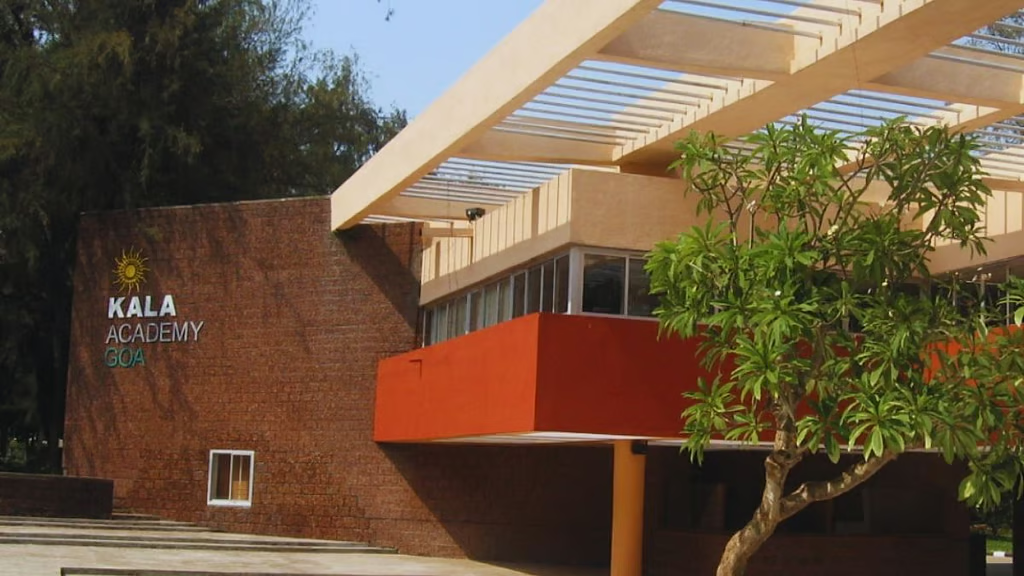
Image credits : Gomantak Times | ART OF THE MATTER : Goa’s Kala Academy is in they eye of the storm following a controversial remark by Goa’s Art and Culture Minister
‘Supari Andolan’ is a creative protest by Goan artists reclaiming a slur to defend the iconic Kala Academy and preserve Charles Correa’s legacy, demanding accountability, transparency and cultural respect.
The once regal Kala Academy, which has hosted many a celebrity and has been the venue of numerous big-ticket events, including the international Film festival of India, has now been reduced to a joke, or rather, a comedy of (contractual) errors.
Just days after the media reported that Kala Academy was likely to be closed for two whole months for ‘rectification’ work, the state government was slammed for continuing to delay the upgrade of the iconic centre of the arts. But what probably evoked widespread public ire was chief minister Pramod Sawant recently saying that the current contractor will complete repairing the rectifications themselves at no additional cost, in keeping with the Kala Academy’s task force suggestion, and complete the work by October this year, in time for IFFI. “Once that is done, the contract will be terminated and the contractor will be blacklisted,” Sawant is reported to have told the media. If this was not enough to enrage citizens, Sawant went a step further by blatantly declaring that new tenders will be floated for additional works that were not covered in the original contract.
The Goa government has blacklisted contractor Techton Buildcon Pvt Ltd due to renovation flaws at the iconic Kala Academy. Critics, including political opposition and artists, raised concerns about light and sound issues. The government canceled the contractor’s annual maintenance contract and a task force will implement remedial recommendations.
The Goa government has taken decisive action by blacklisting Techton Buildcon Pvt Ltd, the contractor responsible for renovating the iconic Kala Academy. This decision follows persistent flaws in the renovation work, which have drawn widespread criticism from opposition parties and local artists.
Chief Minister Pramod Sawant announced that the contractor has until October to rectify these issues at their own expense. Furthermore, plans for a four-year annual maintenance contract with the contractor have been canceled. The decision came in response to disruptions experienced at the 1,000-seat Deenanath Mangeshkar auditorium, including light and sound problems.
The Goa government on Friday said a contractor had been blacklisted for flaws in the renovation of the iconic Kala Academy building here. Chief Minister Pramod Sawant said contractor Techton Buildcon Pvt Ltd has been given time till October this year to rectify the flaws at its own cost. The government has also cancelled a proposal to sign a four-year annual maintenance contract (AMC) with the contractor, Sawant told reporters. The BJP government in the state had come in for criticism from opposition parties and artistes after glitches were observed in the newly-renovated Kala Academy complex, including light and sound disruptions at the 1000-seater Deenanath Mangeshkar auditorium.
The task force constituted to assess and recommend improvements for the Kala Academy’s infrastructure has submitted its final report to Chief Minister Dr. Pramod Sawant. A meeting with the Public Works Department (PWD) and other relevant authorities to review the findings is scheduled for Friday, May 9, 2025.
Speaking at Mantralaya in Porvorim on Thursday, CM Sawant confirmed the submission. “The Task Force on Kala Academy has submitted its report today. I will hold a meeting on this tomorrow. I haven’t gone through the report yet,” he told reporters.
The task force, chaired by renowned theatre artist Vijai Kenkre, was formed in response to mounting concerns from Goa’s arts community, who criticised the ongoing renovation work at the state’s premier cultural complex as haphazard and unstructured, despite substantial expenditure.
Delegation demands minister’s resignation over recurring technical failures and derogatory remarks
In a scathing attack on the State government, a delegation comprising Congress leaders and artistes visited the Kala Academy on Sunday, questioning the authorities over the recurring technical failures at Goa’s premier cultural institution and calling for the resignation of Art and Culture Minister Govind Gaude.
The delegation also demanded that Minister Gaude publicly apologise to veteran actor Sharad Ponkshe and the wider artistic community for derogatorily labelling Ponkshe a ‘Suparibaaz’ following the disruption of his performance last week due to lighting issues at the Academy.
They further claimed that the renovation of the iconic institution—designed by renowned architect Charles Correa—had tarnished Goa’s reputation in the cultural domain.
Minister Govind Gaude blames ‘technical glitch’, not human error
Even after a Rs 50 crore renovation, the Kala Academy — Goa’s premier cultural venue — is facing basic operational failures, with no one willing to take responsibility. The recent light malfunction during a Marathi play has exposed not only technical flaws but also the absence of accountability among the agencies involved.
Art and Culture Minister Govind Gaude on Thursday termed the incident — where stage lights flickered and halted the performance for 10 minutes — as “unfortunate,” but was quick to dismiss it as a technical fault rather than human error.
Here’s a look at how poor planning and botched renovations have plagued Goa’s premier arts institution for over half a century
February 28, 1970 – Goa govt establishes Kala Academy to promote the arts. The iconic building is designed by renowned architect Charles Correa
2004 – Upgraded to serve as a venue for International Film Festival of India
October 30, 2017 – Minister Govind Gaude announces major facelift for Kala Academy
May 23, 2021 – Techton Buildcon Pvt. Ltd. awarded contract for renovation work. Performances come to a standstill
July 17, 2023 – A large portion of open-air auditorium collapses, raising safety concerns
November 10, 2023 – Building reopens after repairs, but concerns about construction quality persist
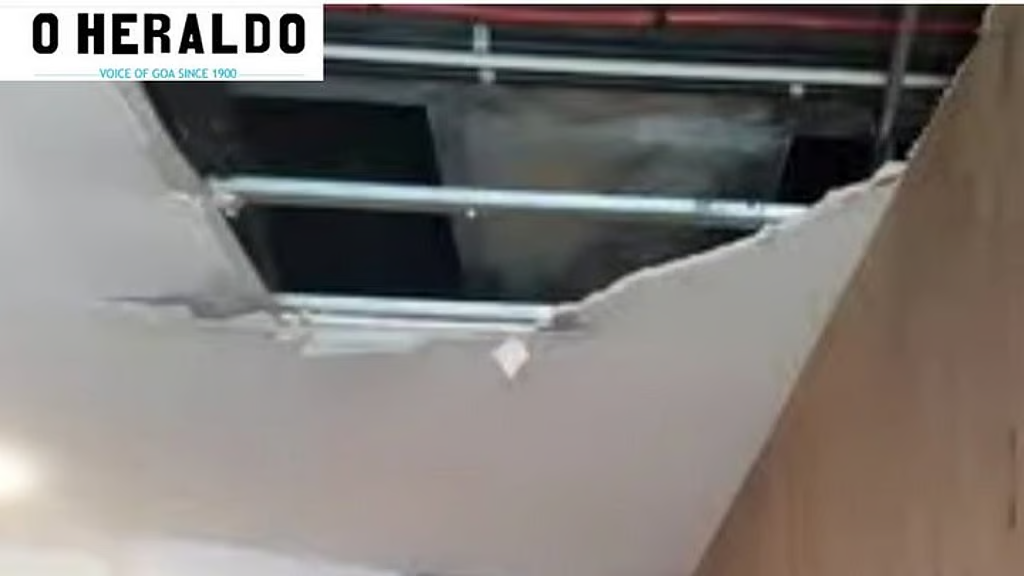
April 22, 2024 – Part of newly-renovated false ceiling crashes due to water leakage
May 20, 2024 – Heavy downpour causes auditorium roof to leak during a performance of the Konkani tiatr ‘Girgirem’
July 8, 2024 – Heavy rains inundate Kala Academy
September 27, 2024 – State govt forms task force led by theatre artist Vijai Kenkre to assess state of building and recommend improvements
October 25, 2024 – Charles Correa Foundation withdraws from offering assistance, citing lack of structural audit
April 13, 2025 – Technical failure in stage lighting causes temporary stoppage of a Marathi play starring Sharad Ponkshe, who apologises to audience
The famed Kala Academy has faced several ignominious setbacks, including flooding from a roof collapse during rains and the partial collapse of its open-air auditorium.
Ahmedabad: Demolition work began on Monday at the Navrangpura bus stand, which was built in 1962-63. It was designed by the master architect Charles Correa. The civic body began this hectic work at what was intended by Correa to be “a prototype for other bus stain the country”.
“Today, our nation is gradually beginning to realise that the process of urbanisation is much more than just the breakdown of Calcutta, or the overcrowding of Kanpur, or the traffic problems of Bombay—it is a phenomenon of unique scope and dimension, one which is going to change fundamentally the nature of our lives. From it will emerge the central, political, human and moral issues of our times, precipitated by the rising expectations of the millions upon millions of our people who want to find a better future.“
-National Commission on Urbanisation, 1988
The growing urban population, especially in medium-size cities! Image source : A New Landscape (1985) page 18.
Nearly 40 years later the report by the National Commission on Urbanisation (1985-1988) exists as a mere reflection of itself. It now lingers as faint murmurs within the syllabus for future IAS officers with fragments finding their way into Indian policy but failing to make a significant enough impact, as its vision remains unfulfilled.
Charles Mark Correa (born, September 1, 1939-died June 16, 2015) was one of India’s leading architects and urban planners. Awarded the title of “Indıa’s greatest archıtect,” by RIBA, Correa has been highly respected both nationally and internationally for his more than 100 constructed projects and architectural approach. Redefining the principles of modernism, the architect rejected cold glass and steel structures, emphasizing the use of local materials in his buildings and harmoniously developing tradition and modernity. Blending India’s cultural and climatic conditions with modern architecture, Charles Correa argued that buildings are not just physical structures, but also spaces that shape the relationship between people and the environment.
Designed to blend seamlessly with its predecessor, the neighboring Cancer Research Centre designed by the late Charles Correa, the Botton-Champalimaud Pancreatic Cancer Centre in Lisbon, Portugal, opened in October 2023.
With a goal to improve treatment and the quality of life for those affected by the disease, the 392,700-square-foot project focuses on operational efficiencies to accelerate treatment and care, bringing together surgical services, research, and clinical trials under one roof.
Innovative architectural features—including round operating rooms with glass walls that change from transparent to opaque at the flip of a switch; infusion bays featuring contemporary pods with views of the water and built-in seating inspired by first-class airline seats; and natural elements such as water features, courtyards, and views of nature—reinforce this strategy while delivering a peaceful environment designed to inspire hope.
The chairman of Ambuja Neotia Group was turned down many times, before building award-winning properties and star hotels with iconic architects B.V. Doshi, Charles Correa and Channa Daswatte.
Harshavardhan Neotia, Chairman of Ambuja Neotia Group, with Charles Correa at City Centre Salt Lake Kund area. | Photo Credit: Special arrangement
Another collaboration that led to one of Kolkata’s earliest and most unique malls was with Charles Correa. He too had initially turned Neotia down when the group went to him with the offer of building a mall. Neotia recollected the incident at the 7th edition of the Charles Correa Memorial Lecture. “I’ve never done a mall, I do not believe in malls and do not want to design one.”
How ironic perhaps that Correa’s design created not just the City Centre Mall in Kolkata but also in Patna, Raipur, Siliguri and Haldia. Unlike most malls across the country, City Centre stood out for its organic blending of community spaces and open air areas with air-conditioned stores. When Correa finally agreed to design the mall for the Neotia group he threw down quite the gauntlet.
“He (Correa) said we are not going to make a mall like everyone else does. I was very happy because I thought maybe he would do something new in terms of design. I did not know what I was getting into (laughs). That he would persuade me to do a bazaar crossover with a mall with community spaces within the mall was beyond my imagination. When we built the City Centre, Kolkata already had certain expectations of what a mall would look like. Ansal Plaza in Delhi and Crossroads in Mumbai had already opened so people had a sort of a set idea.” Even now nearly 20 years after the mall first opened there is something inherently organic about City Centre where the “Kund area” has an outdoor amphitheatre surrounded by stores and restaurants and one can choose between air-conditioned comfort or basking in the sun. Neotia describes Correa’s aesthetic “as one characterised by fluid spaces and a deep understanding of urban context. In City Centre, this is evident in the seamless flow between indoor and outdoor areas.”“He (Correa) said we are not going to make a mall like everyone else does. I was very happy because I thought maybe he would do something new in terms of design. I did not know what I was getting into (laughs). That he would persuade me to do a bazaar crossover with a mall with community spaces within the mall was beyond my imagination. When we built the City Centre, Kolkata already had certain expectations of what a mall would look like. Ansal Plaza in Delhi and Crossroads in Mumbai had already opened so people had a sort of a set idea.”
Even now nearly 20 years after the mall first opened there is something inherently organic about City Centre where the ‘Kund area’ has an outdoor amphitheatre surrounded by stores and restaurants and one can choose between air-conditioned comfort or basking in the sun. Neotia describes Correa’s aesthetic “as one characterised by fluid spaces and a deep understanding of urban context. In City Centre, this is evident in the seamless flow between indoor and outdoor areas.”
Architect, planner, activist and theoretician, Charles Correa is one of the few contemporary architects who addresses not only issues of architecture, but of low-income housing and urban planning as well. His work covers a wide range, from the Mahatma Gandhi Memorial at the Sabarmati Ashram in Ahmedabad, the Jawahar Kala Kendra in Jaipur and the State Assembly for Madhya Pradesh, to housing projects and townships in Delhi, Bombay, Ahmedabad and Bangalore. He was Chief Architect for ‘Navi Mumbai’ the new city of 2 million people across the harbour from Bombay, and was appointed by Prime Minister Rajiv Gandhi as the first Chairman of the National Commission on Urbanisation.
Correa has taught at several universities, both in India and abroad, and currently spends part of his time at the Massachusetts Institute of Technology, where he is Farwell Bemis Professor in the School of Architecture and Planning. He has been awarded the highest honours of his profession, including the Aga Khan Award for Architecture, the Praemium Imperiale of Japan, and the Gold Medals of the UIA and the RIBA
EDUCATION
1939 – 1946
St. Xavier’s High School, Bombay
1946 – 1948
St. Xavier’s College, University of Bombay
1949 – 1953
University of Michigan (B.Arch)
1953 – 1955
Massachusetts Institute of Technology (M.Arch)
PROFESSIONAL AFFILIATIONS
1964 – 2015
Fellow, Indian Institute of Architects
1974 – 2015
Council of Architecture, India
HONORARY FELLOWSHIPS
1979
American Institute of Architects, Washington, DC
1985
Academie d’ Architecture Francais, Paris
1987
International Academy of Architecture, Sofia, Bulgaria
1990
United Architects of the Philippines, Manila
1992
Finnish Institute of Architects, Helsinki, Finland
1993
Royal Institute of British Architects, London
1993
American Academy of Arts and Sciences, Cambridge, Mass
1997
Royal Institute of Architects of Ireland, Dublin
1998
American Academy of Arts and Letters, New York, NY
1999
Trinidad Institute of Architects, Jamaica
2002
Royal Architectural Institute of Canada, Winnipeg, Canada
PROFESSIONAL EXPERIENCE
1958
In private practice in Bombay
1964 – 1965
Prepared alternate Master Plan (with Pravina Mehta & Shirish Patel) proposing city of New Bombay
1969 – 1971
Invited by the Government of Peru and the UN to design PREVI low–cost housing project in Lima
1971 – 1974
Chief Architect to CIDCO (Government of Maharashtra) for development of New Bombay
‘Object on View’, by Michael Brawne, The Architectural Review, London – November, p. 246
1960
‘India & Pakistan’, by John Writer, Architectural Design, London – April, pp. 156-157
1961
‘The Michigan Influence in Architecture – Bombay’ by R. B. Lytle, Michigan Alumnus, Ann Arbor – p. 53
GANDHI SMARAK SANGRAHALAYA 1958-63
Sabarmati Ashram, Ahmedabad, Gujarat
Journals
1960
‘India & Pakistan’, by John Writer, Architectural Design, London – April, pp. 156-157
1963
‘Gandhi Smarak Sangrahalaya’, Indian Institute of Architects Journal, Bombay – April, pp. 26-38
1964
‘Indian Revisions’, Architectural Review, London – April, pp. 235-236
1977
‘Quarttro Lavori di Correa’, L’Architectura, Rome – March, pp. 640-646
1980
‘Report from India: Current work of Correa’, by H. Smith, Architectural Record, New York – July, pp. 88 – 89
1980
‘Contemporary Asian Architecture’, Process Architecture – 20, Tokyo – November, pp. 94 -118
Books
1987
A History of Architecture, by Sir Banister Fletcher, 19th Edition, Butterworth, London, p. 1494
1991
Architecture of SARC Nations, by Razia Grover and S.K. Das, Media Transasia (I), Delhi, p. 52
2000
World Architecture, A Critical Mosaic 1900-2000, Vol. 8, South Asia, Ed. Rahul Mehrotra, Pub. China Architecture and Building Press and SpringerWienNewYork, pp. 112 – 113
HINDUSTAN LEVER PAVILION 1961
Pragati Maidan, New Delhi
Journals
1960
‘Hindustan Lever Pavilion’, Architectural Review, London – July, p. 57
1961
‘Indian Pavilion’, Architectural Forum, New York – January, p. 132
1962
‘Concrete’, by Peter Blake, Architectural Forum, New York – September, p. 78
NATIONAL CRAFTS MUSEUM 1975-93
New Delhi, Delhi
Journals
1979
‘Crafts Museum’, by S. Baxi, Museum, London – April, pp. 374-377
1980
‘Contemporary Asian Architecture’, Process Architecture – 20, Tokyo – November, pp. 94-118
1991
‘Charles Correa’, by Satish Grover, Architecture + Design, Delhi – September, pp. 15-45
1994
‘Pradakshina: The Works of Charles Correa’, Special Report, Approach, Tokyo – Summer, cover & pp. 1-23
1995
‘Indian Intricacy’ by Robert Powell, The Architectural Review, London – August, pp. 52-55
1996
‘Charles Correa’, SPACE, Seoul, Korea, pp. 28 – 47
Books
1995
Contemporary Asian Architects, by Hasan-Uddin Khan, Taschen, Koln London NewYork, pp. 88 – 89
JAWAHAR KALA KENDRA 1986-92
Jaipur, Rajasthan
Journals
1988
L’Inde Intemporelle’, Techniques & Architecture, Paris – February, pp. 86-97
1991
‘Charles Correa’, by Satish Grover, Architecture + Design, Delhi – September, pp. 15-45
1991
‘Charles Correa’s Architecture’ by Sarayu Ahuja, Indian Architect & Builder, Bombay – October, pp. 20-26
1991
‘Jawahar Kala Kendra’, Architectural Design, London, November, pp. 92-96
1991
‘Espacos para a India’, by C. Dibar/ D. Armando, Arqitectura Urbanisma, Buenos Aires, December, pp. 44-51
1992
‘Mystic Labyrinth’, The Architectural Review, London, January, pp. 20-26
1992
‘Squaring the Circle’, Architectural Record, New York – March, pp. 98-105
1992
‘Musee a Jaipur, Inde’, Techniques & Architecture, Paris – April, pp. 24-3
1992
‘Jawahar Kala Kendra’, Interior # 36, Sydney – October, pp. 94-105
1992
‘Jawahar Kala Kendra’, Spazio e Societa # 60, Firenze – October-December, pp. 114-121
1993
‘Charles Correa: Ein Museum’ by Gautam Bhatia, Der Architekt, BDA, Berlin – February, pp. 89-92
1993
‘Jawahar Kala Kendra’, Progressive Architecture, New York – April, pp. 86-87
1994
‘Charles Correa’, A+U Vol. 94:01, Tokyo – January, cover and pp. 9-77
1994
Pradakshina: The Works of Charles Correa’, Special Report, Approach, Tokyo – Summer, cover & pp. 1-23
1996
‘Charles Correa’, SPACE, Seoul, Korea, pp. 28 – 47
1996
‘Charles Correa – Magishe Mandela und dorfliche Strukturn: Vor-Bilder fur eine neue Architektur’ Architektur & Wohen, pp. 112 – 116
1996
‘Charles Correa: Jawahar Kala Kendra’, Light in Architecture, A & D, London, pp. 92 – 96
1998
‘Charles Correa: Architektur als Modell des Kosmos’, Vielfaches Echo, Stuttgart, April-June, pp. 84-87
1998
‘Charles Correa’, Materia 28, Modena, Italy, September, pp. 36-41 & back cover
2001
‘Habitat: Conceitos e estrategias’,by Rui Barreiros Duarte,Arquitectura e vida,Lisboa-June, Cover & pp. 28-33
Books
1991
100 Contemporary Architects: Drawings & Sketches, by Bill Lacy, Thames & Hudson, London, pp. 60 – 63
1994
Contemporary Architecture in Asia, KIRA, Seoul, pp. 28 – 31
1996
Architecture After Modernism by Diane Ghirado, Thames & Hudson, London, pp. 93 – 95
1997
Contemporary Vernacular, by William Lim & Tan Hock Beng, Select Books, Singapore, pp. 66 – 75
2000
World Architecture, A Critical Mosaic 1900-2000, Vol. 8, South Asia, Ed. Rahul Mehrotra, Pub. China Architecture and Building Press and SpringerWienNewYork, pp. 230 – 233
2000
India Modern, by Herbert J. M. Ypma, published by Phaidon Press Ltd., pp. 218 – 229
2002
30 Years After, The Future of the Past, by Gyorgy Keves, published by Kiado, Epiteszet es Muveszet & Keves Studio Galeria, Budapest, Hungary, pp. 47, 50 – 51
‘International Architectural Competition for a Museum of Islamic Arts in Qatar’, Kumbez, Russia-January, p. 23
1998
‘Islam Sanatlari Muzesi’, Dekorasyon, Istanbul – January, pp. 87-88
1998
‘Qatar Islamic Museum Competition’, Albenaa, Riyadh, January-February, pp. 54-56
1998
‘Aga Han Kultur Vakfi’nin Duzenledigi Doha’da’, Tasarim, Istanbul – February, pp. 78-80
1998
‘Doha Museum of Islamic Arts’, Indian Architect & Builder, March pp. 80 – 85
1998
‘Museum of Islamic Arts’, The Architectural Review, Special Issue: Middle East – March, p. 27 (3)
Books
2000
Asian Architects 2, Edited by Tan Kok Meng, Select Publishing Pte Ltd, Singapore, pp. 120 – 123
INSTITUTIONS
ADMINISTRATION BUILDING 1958-60
Anand, Gujarat
Journals
1964
‘Indian Revisions’, Architectural Review, London – April, pp. 235-236
HUMANITIES DEPARTMENT 1959-60
Anand, Gujarat
Journals
1961
‘The Michigan Influence in Architecture – Bombay’ by R. B. Lytle, Michigan Alumnus, Ann Arbor – p. 53
KALA AKADEMI 1973-83
Panaji, Goa
Journals
1985
‘Charles Correa: Inspirations Indiennes’, Techniques & Architecture, Paris – August, pp. 106-117
1987
‘Kala Akademi’, Mimar, Singapore – March, pp. 27-31
SURYA KUND 1986
New Delhi, Delhi
Journals
1988
‘L’Inde Intemporelle’, Techniques & Architecture, Paris – February, pp. 86-97
BRITISH COUNCIL 1987-92
New Delhi, Delhi
Journals
1992
‘Destiny & Design’, by Jahanara Wasi, The Fountainhead, Bombay – May, pp. 19-23
1992
‘Better Council’, by Mina Singh, Inside Outside, Bombay – July, pp. 14-22
1994
‘Pradakshina: The Works of Charles Correa’, Special Report, Approach, Tokyo – Summer, cover & pp. 1-23
1994
‘Suns of Goa’, by Chintamani Bhagat, Indian Architect & Builder, Bombay – August, Cover and pp. 10-35
1996
‘Charles Correa’, SPACE, Seoul, Korea, pp. 28 – 47
1996
‘Charles Correa: Jawahar Kala Kendra’, Light in Architecture, A & D, London, pp. 92 – 96
1997
‘Charles Correa dan Iki Ornek’ by Ebru Ozeke, YAPI 183, Istanbul, February pp. 73 – 87
2001
‘Habitat: Conceitos e estrategias’,by Rui Barreiros Duarte, Arquitectura e vida, Lisboa-June, Cover & pp. 28-33
Books
1995
Contemporary Asian Architects, by Hasan-Uddin Khan, Taschen, Koln London New York, pp. 90 – 91
2000
World Architecture, A Critical Mosaic 1900-2000, Vol. 8, South Asia, Ed. Rahul Mehrotra, Pub. China Architecture and Building Press and SpringerWienNewYork, pp. 228 – 229
2000
Asian Architects 2, Edited by Tan Kok Meng, Select Publishing Pte Ltd, Singapore, pp. 106 – 109
2002
30 Years After, The Future of the Past, by Gyorgy Keves, published by Kiado, Epiteszet es Muveszet & Keves Studio Galeria, Budapest, Hungary, pp. 48 – 49
SALVACAO CHURCH 1974-85
Mumbai, Maharashtra
Journals
1980
‘Report from India: Current work of Correa’, by H. Smith, Architectural Record, New York – July, pp. 88
Books
1980
Arkitekten der Dritten Welt, by Udo Kultermann, (DuMont) Buchverlag Koln, p. 117
INTER-UNIVERSITY CENTRE FOR ASTRONOMY AND ASTROPHYSICS 1988-92
Pune, Maharashtra
Journals
1994
‘Charles Correa’, A+U Vol. 94:01, Tokyo – January, cover and pp. 9-77
1994
‘IUCAA’, by Dr. Jayant Narlikar, Southern Sky, Weston Creek, Australia – May /June, pp. 22-25
1994
‘Pradakshina: The Works of Charles Correa’, Special Report, Approach, Tokyo – Summer, cover & pp. 1-23
1994
‘Suns of Goa’, by Chintamani Bhagat, Indian Architect & Builder, Bombay – August, Cover and pp. 10-35
1994
‘Centro di Astronomia e Astrofiscia’, Arbitaire 332, Editrice Abitaire Segesta, Milano, September, pp. 180-181
1996
‘Charles Correa’, SPACE, Seoul, Korea, pp. 28 – 47
1997
‘Charles Correa dan Iki Ornek’ by Ebru Ozeke, YAPI 183, Istanbul, February pp. 73 – 87
1998
‘Charles Correa: Architektur als Modell des Kosmos’, Vielfaches Echo, Stuttgart, April-June, pp. 84-87
Books
1995
Contemporary Asian Architects, by Hasan-Uddin Khan, Taschen, Koln London New York, pp. 92 – 93
1995
The Architecture of the Jumping Universe, by Charles Jencks, Academy Editions, London, pp. 134 – 135
2001
Indian Art, by Partha Mitter, published by Oxford University Press, pp. 203 – 205
WORK PLACES
GUN HOUSE 1960-62
Ahmedabad, Gujarat
Journals
1965
‘Gun House’, Architectural Review, London – July, pp. 59-60
1966
‘Three in Ahmedabad’, Indian Institute of Architects Journal, Bombay – July, pp. 15-21
ECIL Office Complex 1965-68
Hyderabad, Telangana
Journals
1980
‘Report from India: Current work of Correa’, by H. Smith, Architectural Record, New York – July, pp. 88-89
Books
1980
Arkitekten der Dritten Welt, by Udo Kultermann, (DuMont) Buchverlag Koln, p. 116
MRF HEADQUARTERS 1987-92
Chennai, Tamil Nadu
Journals
1992
‘Madras Rubber Factory’, Architecture+Design, Delhi, November-December, pp. 104-113
1998
‘Recalling the Waves’ by Geeta Doctor, Inside Outside, Bombay, March pp. 164 – 167
2001
‘Edificio Per Uffici a Madras, India’, by Marco Santacesaria, L’Industria Italiana del Cemento, Roma – March, pp. 181-185
JEEVAN BHARATI 1975-86
New Delhi, Delhi
Journals
1992
‘Life Insurance Corporation’, Architecture+Design, Delhi – November-December, pp. 10-37
VIDHAN BHAVAN 1980-97
Bhopal, Madhya Pradesh
Journals
1985
‘A Style for the Year 2001’, Japan Architect / A+U, Tokyo – Summer, pp. 84-88
‘L’Inde Intemporelle’, Techniques & Architecture, Paris – February, pp. 86-97
1998
‘State of Assembly’ by Penelope Digby-Jones, Architectural Review, London, August, pp. 50 – 55
1998
‘Charles Correa- Indian State Assembly’, Dialogue, Taiwan – April, pp. 56-61
1998
‘The Aga Khan Award: Honouring Substance Over Style’, by Robert Campbell, Architectural Record, New York – November, p. 70
1998
‘Vidhan Bhavan, Bhopal, Hindistan’,1998 Aga Han Mimarlik Odulleri by Derya Nuket Ozer, YAPI, Istanbul, November, pp. 86-87
1998
‘Vidhan Bhavan, India’, Aga Khan Awards, Architecture+Design, Delhi – November-December, pp. 120-121
1999
’10 Architects who count’, by Sarayu Ahuja, Indian Architect & Builder, Mumbai – January, pp. 37-44
1999
‘Paramento Vidhan Bhavan’ Norma e forma by Gunther Uhlig, Domus, Milano, Italy, October, pp. 31-39
1999
‘Cultural Motifs- Charles Correa’ by Amy Liu, ‘Space’, Hong Kong, November, pp. 104-105 & 109-117
2000
‘Vidhan Bhavan – Bhopal’, by Andrea Anastasio, Abitare, Italy – August, pp. 104-107
2001
‘Habitat: Conceitos e estrategias’,by Rui Barreiros Duarte,Arquitectura e vida,Lisboa-June, Cover & pp. 28-33
Books
1998
Legacies for the Future, The Contemporary Architecture in Islamic Societies, Edited by Cynthia Davidson, Thames & Hudson and The Aga Khan Award for Architecture, London, pp. 128 – 143
2000
World Architecture, A Critical Mosaic 1900-2000, Vol. 8, South Asia, Ed. Rahul Mehrotra, Pub. China Architecture and Building Press and SpringerWienNewYork, pp. 240 – 241
2000
Asian Architects 2, Edited by Tan Kok Meng, Select Publishing Pte Ltd, Singapore, pp. 112 – 119
2001
New Vernacular Architecture, by Vicky Richardson, published by Laurence King Publishing, pp. 214 – 217
2002
Civic Builders, Edited by Curtis W. Fentress, published by Wiley-Academy, pp. 130 – 137
2002
30 Years After, The Future of the Past, by Gyorgy Keves, published by Kiado, Epiteszet es Muveszet & Keves Studio Galeria, Budapest, Hungary, pp. 52 – 53
PERMANENT MISSION OF INDIA TO THE U.N 1985 – 92
New York, USA
Journals
1993
‘Indian Mission’, by Peter Slatin, Oculus, AIA, N.Y. Chapter – June, cover and p. 7
1997
‘A Strip of India’ Indian Design & Interiors, Delhi, August-September, pp. 61 – 65
1999
Cultural Motifs- Charles Correa’ by Amy Liu, ‘Space’, Hong Kong, November, pp. 104-105 & 109-117
Books
1997
New York, by Susanna Sirefman, Ellipsis London Limited, London, pp. 160 – 161
2002
Sky High Living, Contemporary High Rise Apartment and Mixed Use Building, Edited by Georges Binder, published by Images Publishing, pp. 56 – 57
LEISURE
CAMA HOTEL 1958-60
Ahmedabad, Gujarat
Journals
1960
‘Cama Hotel, Ahmedabad’, Design, Delhi – September, cover and pp. 32-35
1960
India Pakistan and Ceylon, July 1960
1961
‘The Michigan Influence in Architecture – Bombay’ by R. B. Lytle, Michigan Alumnus, Ann Arbor – p. 53
Books
1961
New Buildings in the Commonwealth, Edited by J. M. Richards, Architectural Press, London, p. 184
CIDADE DE GOA 1978 – 82
Dona Paula, Goa
Journals
1982
‘Faked Facades’, by Susan Stephens, Skyline, New York – July, p. 24
1982
‘Cidade de Goa’, by Brian Brace Taylor, Mimar, Singapore – July, cover and pp. 44-49
1982
‘Cidade de Goa’, Inside Outside, Bombay – October, cover and pp. 14-21
1983
‘Cidade de Goa’, by Shalini Ramgopal, Namaste, March, pp. 34-38
1984
‘Cidade de Goa’, A+U, Tokyo – June, pp. 100-107
1985
‘Charles Correa: Inspirations Indiennes’, Techniques & Architecture, Paris – August, pp. 106-117
1990
‘Charles Correa’, Alam Al Bena, Cairo – April, Issue 114, pp. 15-16
1991
‘Espacos para a India’, by C. Dibar/ D. Armando, Arqitectura Urbanisma, Buenos Aires, December, pp. 44-51
Books
1985
The City in Conflict: Edited by Chris Johnson, The Law Book Co. Ltd., Sydney, pp. 40 – 41
KOVALAM BEACH RESORT 1969-74
Kerala
Journals
1977
‘Quarttro Lavori di Correa’, L’Architectura, Rome – March, pp. 640-646
1980
‘Report from India: Current work of Correa’, by H. Smith, Architectural Record, New York – July, pp. 88-89
BAY ISLAND RESORT 1979-82
Port Blair, Andaman Island
Journals
1983
‘Bay Islands’, Namaste, March, pp. 13-16
1987
‘Climate as Context’, by Mildred Schmertz, Architectural Record, New York – August, pp. 114-119
DONA SLYVIA 1988-91
Cavelossim Beach, Goa
Journals
1993
‘Many Villages make a Hotel’, by Anupam Pruthi, Inside Outside, Bombay – December, pp. 140-145
Housing
STAFF HOUSING TISS 1958
Mumbai, Maharashtra
Journals
1958
‘Housing at Trombay’, Design, Bombay – August, pp. 8-9
TWIN HOUSES 1959 – 60
Bhavnagar, Gujarat
Journals
1960
‘India & Pakistan’, by John Writer, Architectural Design, London – April, pp. 156-157
1961
‘Twin Houses’, Indian Institute of Architects Journal, Bombay – April, pp. 14-15
TUBE HOUSES 1961 – 62
Ahmedabad, Gujarat
Journals
1966
‘Three in Ahmedabad’, Indian Institute of Architects Journal, Bombay – July, pp. 15-21 Books
Books
1973
Building Environment by Balwant Singh Saini, Angus and Robertson, Sydney, p. 94
SONMARG APARTMENTS 1961 – 66
Mumbai, Maharashtra
Journals
1970
‘Un Appartement a Bombay’, by P. Bailhache, La Maison De Marie-Claire, Paris – March, pp. 88-89
DUTTA HOUSE 1965 – 66
Hauz Khas, New Delhi
Journals
1988
‘A Gallery of Art’, by Nandini Kapur, Inside Outside, Bombay – August, cover & pp. 94-101
PAREKH HOUSE 1967 – 68
Ahmedabad, Gujarat
Journals
1980
‘Report from India: Current work of Correa’, by H. Smith, Architectural Record, New York – July, pp. 88-89
1980
‘Contemporary Asian Architecture’, Process Architecture – 20, Tokyo – November, pp. 94-118 Books
Books
1973
Building Environment by Balwant Singh Saini, Angus and Robertson, Sydney, p. 97
1987
A History of Architecture, by Sir Banister Fletcher, 19th Edition, Butterworth, London, p. 1494
RAMAKRISHNA HOUSE 1962 – 64
Ahmedabad, Gujarat
Journals
1966
‘Three in Ahmedabad’, Indian Institute of Architects Journal, Bombay – July, pp. 15-21
1972
‘Correa and Kanvinde’, Architectural Review, London – August, p. 123
1973
‘Defeating the Climate’, by Peter Blake, Sunday Telegraph Magazine, London – September, pp. 82-88
1977
‘Quarttro Lavori di Correa’, L’Architectura, Rome – March, pp. 640-646
1980
‘Report from India: Current work of Correa’, by H. Smith, Architectural Record, New York – July, pp. 88-89
Books
1973
Building Environment by Balwant Singh Saini, Angus and Robertson, Sydney, p. 95
1980
Arkitekten der Dritten Welt, by Udo Kultermann, (DuMont) Buchverlag Koln, pp. 114 – 115
JEEVAN BIMANAGAR TOWNSHIP 1969 – 72
Mumbai, Maharashtra
Journals
1977
‘Quarttro Lavori di Correa’, L’Architectura, Rome – March, pp. 640-646
PREVI HOUSING 1969 – 73
Lima, Peru
Journals
1970
‘Previ Project’, Architectural Design, London – April, p. 198
KANCHANJUNGA APARTMENTS 1970 – 83
Mumbai, Maharashtra
Journals
1974
‘Apartments’, Architecture Plus, New York – March, p. 26
1980
‘Report from India: Current work of Correa’, by H. Smith, Architectural Record, New York – July, pp. 88-89
1980
‘Contemporary Asian Architecture’, Process Architecture – 20, Tokyo – November, pp. 94-118
1982
‘Open the Box’, by Jim Murphy, Progressive Architecture, New York – October, pp. 100-104
1983
‘Kanchanjunga Apartments’, Architect, Melbourne – December, pp. 12-13
1985
‘Charles Correa: Inspirations Indiennes’, Techniques & Architecture, Paris – August, pp. 106-117
1985
‘Edificio residenziale a torre a Bombay’, by C. M. Pierdominici, Cemento, Rome – October, pp. 642-651
1991
‘Espacos para a India’, by C. Dibar/ D. Armando, Arqitectura Urbanisma, Buenos Aires, December, pp. 44-51
1999
‘Cultural Motifs- Charles Correa’ by Amy Liu, ‘Space’, Hong Kong, November, pp. 104-105 & 109-117
Books
1990
After the Masters, by Vikram Bhatt & Peter Scriver, Mapin, Ahmedabad, pp. 64 – 67
1999
Outside Architecture, by Susan Zevon, Rockport Publishers, Massachusetts, pp. 27 – 29
2000
World Architecture, A Critical Mosaic 1900-2000, Vol. 8, South Asia, Ed. Rahul Mehrotra, Pub. China Architecture and Building Press and SpringerWienNewYork, pp. 172 – 175
2000
Asian Architects 2, Edited by Tan Kok Meng, Select Publishing Pte Ltd, Singapore, pp. 110 – 111
2002
Sky High Living, Contemporary High Rise Apartment and Mixed Use Building, Edited by Georges Binder, published by Images Publishing, p. 25
TARA HOUSING 1975 – 78
New Delhi
Journals
1980
‘Report from India: Current work of Correa’, by H. Smith, Architectural Record, New York – July, pp. 88-89
1980
‘Contemporary Asian Architecture’, Process Architecture – 20, Tokyo – November, pp. 94-118
1982
‘Open the Box’, by Jim Murphy, Progressive Architecture, New York – October, pp. 100-104
1985
‘Charles Correa: Inspirations Indiennes’, Techniques & Architecture, Paris – August, pp. 106-117
Books
1990
After the Masters, by Vikram Bhatt & Peter Scriver, Mapin, Ahmedabad, pp. 56 – 59
1991
Architecture of SARC Nations, by Razia Grover and S.K. Das, Media Transasia (I), Delhi, p. 51
BELAPUR LOW INCOME HOUSING 1983 – 86
Navi Mumbai, Maharashtra
Journals
1982
‘Open the Box’, by Jim Murphy, Progressive Architecture, New York – October, pp. 100-104
1985
‘Belapur Housing’, Mimar, Singapore – July, pp. 34-40
1985
‘Correa Courts’, by Peter Davey, Architectural Review, London – October, pp. 32-35
1993
‘Public Sector Mass Housing’, by Babar Mumtaz, Design Ideas, Bombay – April, cover & pp. 5-9
Books
1987
A History of Architecture, by Sir Banister Fletcher, 19th Edition, Butterworth, London, pp. 1494 – 1495
1990
After the Masters, by Vikram Bhatt & Peter Scriver, Mapin, Ahmedabad, pp. 100 – 103
1991
Architecture of SARC Nations, by Razia Grover and S.K. Das, Media Transasia (I), Delhi, p. 79
1995
Contemporary Asian Architects, by Hasan-Uddin Khan, Taschen, Koln London New York, pp. 86 – 87
1996
Architecture After Modernism by Diane Ghirado, Thames & Hudson, London, pp. 155 – 156
HOUSE AT KORAMANGALA 1985 – 89
Bangalore, Karnataka
Journals
1992
‘The House Around a Temple Tree’, by Chandroo Iyer, Interiors India, Bombay – Annual, pp. 86-97
Books
1996
The Tropical Asian House, by Robert Powell, Select Books, Singapore, pp. 110 – 115
1999
Outside Architecture, by Susan Zevon, Rockport Publishers, Massachusetts, pp. 20 – 25
HUDCO COURTYARD HOUSING ( UNBUILT ) 1986
Jodhpur, Rajasthan
Journals
1988
‘L’Inde Intemporelle’, Techniques & Architecture, Paris – February, pp. 86-97
JAWAHARLAL NEHRU INSTITUTE OF DEVELOPMENT BANKING 1986 – 91
Hyderabad, Telangana
Journals
1991
‘Charles Correa’, by Satish Grover, Architecture + Design, Delhi – September, pp. 15-45
1993
‘Jawaharlal Nehru Institute for Development Banking’, by Mina Singh,Inside Outside,Bombay-September, pp.14-21
MHADA HOUSING ( COMPETITION ) ( UNBUILT ) 1999
Mumbai, Maharashtra
Journals
1999
‘MHADA: Redevelopment of Transit Camps’, Indian Architect & Builder, Mumbai, August, pp. 30-32
URBANISATION
PLANNING FOR NEW BOMBAY 1964 – 74
Navi Mumbai, Maharashtra
Journals
1981
‘Using the Past to Invent the Future’, Spazio e Societa, Milano – December, pp. 56-63
Books
1980
Arkitekten der Dritten Welt, by Udo Kultermann, (DuMont) Buchverlag Koln, p. 119
1985
The City in Conflict: Edited by Chris Johnson, The Law Book Co. Ltd., Sydney, pp. 30 – 39
2000
Architecture & Identity: Responses to cultural and technological change, by Chris Abel, UK, pp. 212 – 215
2005
30 Years After, The Future of the Past, by Gyorgy Keves, published by Kiado, Epiteszet es Muveszet & Keves Studio Galeria, Budapest, Hungary, p. 46
GOA PLANNING
Goa
Journals
1974
Goa Planning, Conservation and Control, pp. 33 – 37
BAGALKOT TOWNSHIP 1985 – 1990
Bagalkot, Karnataka
Journals
1988
‘L’Inde Intemporelle’, Techniques & Architecture, Paris – February, pp. 86-97
Books
2000
Architecture & Identity: Responses to cultural and technological change, by Chris Abel, UK, p. 231
BUDDHAPURNIMA LAKEFRONT DEVELOPMENT 1982 – 85
Hyderabad, Telangana
Journals
2000
‘In progress’, by Ajay Nayak, Indian Architect & Builder, Mumbai – June, pp. 28-30
2001
‘Bharat Bhavan,Sunken court at Sanjeevaiah Park’,Form,Technique,Content,NSW, Australia, February, pp. 21-25
In 1986 Prime Minister Rajiv Gandhi appointed Correa as Chairman of the first-ever National Commission on Urbanization. Their mandate: to take a holistic overview of the urban situation across the country, so the Government could develop new policies on issues crucial to India’s future. Over a period of two years, the Commission visited all the States and Union Territories of India, meeting with the key leaders of the State Governments and concerned citizens and NGOs. The Commission submitted its Interim Report in 1987, and a year later in 1988, presented to the Government of India its Final Report of 14 volumes, covering a wide range of issues – from identifying new growth centers to squatter housing, to the provision of public transport. Major thrust of the report was the issue of Urban Poverty to Urban Form, to the Governance of our cities.