Author: Haindhavi Paruchuri Site Location: Shamshabad, Hyderabad Institute: Gitam (Deemed to be University) Advisor: Sneha S. Reddy
description
The Bioclimatic Film Institute is a pioneering hub where filmmaking harmonizes with environmental sustainability. Designed with advanced bioclimatic strategies, this institute embodies a commitment to eco-friendly practices while providing a state-of-the-art space for creative expression. The building features passive solar design, natural ventilation, ensuring energy efficiency and a minimal carbon footprint. Inside, filmmakers have access to cutting-edge, low-energy equipment and sustainable materials. Our classrooms, studios, and screening rooms are designed to maximize natural light and reduce energy consumption, creating a healthy, inspiring environment for both students and professionals. The institute also offers educational programs and workshops focused on integrating sustainability into film production. By blending artistic innovation with ecological responsibility, the Bioclimatic Film Institute sets a new standard for how creative spaces can contribute to a greener future.
Author: Kartik Kohade Site Location: Nagpur, Maharashtra Institute: Poornima University Advisor: Ar. Sumeet Rai
description
This thesis delves into the architectural design of “Navchetna Kendra,” a pioneering rehabilitation center tailored for individuals grappling with Post-Traumatic Stress Disorder (PTSD). The increasing prevalence of PTSD underscores the critical need for environments that not only provide medical and psychological support but also foster an atmosphere conducive to healing. Navchetna Kendra aims to meet this need by integrating innovative architectural strategies that emphasize tranquility, safety, and sensory comfort. The design leverages principles of biophilic design, which connects occupants with nature to enhance psychological well-being, alongside principles of sensory modulation to address specific PTSD symptoms such as hypervigilance and anxiety. Key features include therapeutic landscapes, private and communal spaces carefully designed to balance solitude and social interaction, and adaptive environments that respond to the evolving needs of patients. Through a detailed exploration of spatial layouts, materiality, and environmental control, this thesis investigates how architectural design can significantly impact the recovery process, providing insights into creating environments that not only support clinical interventions but also facilitate holistic healing and resilience.
Author: Akshath Reddy Site Location: Hyderabad, Telengana Institute: Acharya’s NRV School of Architecture Advisor: Ar. Malavika Jayachandran
description
This project embarks on a transformative journey to redefine sustainability within the architectural realm, aligning with global initiatives such as the G20 and UN 2030 Goals. Focusing on an Aerospace Research and Development Center, the project probes the critical question: how can architects integrate sustainable practices into real-world designs to mitigate environmental impacts? Recognizing the construction industry’s contribution to 30-40% of global waste, this project aims to create a carbon-neutral building, reducing pollution from design to demolition. By positioning architecture as a catalyst for change, it sets a precedent for minimizing the environmental footprint of the built environment. The design incorporates both active and passive strategies, including optimal plan depth ratios, relative compactness, and precise building orientation. A rigorous, data-driven approach, supported by simulations such as CFD, energy, and shadow analysis, ensures that every decision is informed by research from leading global institutions. Key technologies-Energy Simulation, Circular Economy principles, and Digital Twin Technology-underscore the project’s innovative approach. This initiative exemplifies the architect’s role in crafting spaces that not only adapt to but also positively influence their climate and context, paving the way for a more sustainable future.
Title Charles Correa: Citizen Charles /Author Mustansir Dalvi / Publisher Niyogi Books /Pages 204 / Price Rs 299
In 1948, when Charles Correa left for the US, India, newly independent, was still reeling from the trauma of the Partition and the assassination of the Father of the Nation, Mahatma Gandhi. When he returned to Bombay in 1956, the country had consolidated into a republic with a new Constitution, the first General Election had been held in 1951, and the new institutions of an independent state were steadily being established. The image of the nation state was, very substantially, being crafted by Jawaharlal Nehru, India’s first Prime Minister. His vision for the modern nation was pitted against the baggage of the past, both colonial and pre-colonial, and the burdens of tradition, ritual, and belief.
Mumbai—Charles Correa’s beloved city, described by him as “a great city, but a terrible place”—set the stage for the sixth edition of the Z-axis conference, organised by the Charles Correa Foundation (CCF) on October 12 and 13, 2024. Held at the NCPA experimental theatre, the conference celebrated Correa’s multifaceted legacy and explored his projects, philosophies, writings and advocacy for urbanisation. Correa, widely acclaimed as a visionary of post-independence modernist architecture in India, demonstrated an innate curiosity in numerous disciplines which imperceptibly reflected in his expansive repertoire. Spanning six sessions, the conference brought together 21 speakers from diverse fields to reflect on Correa’s protean disposition. The overarching theme captured Correa’s contribution to India’s post-independent search for identity and his ideas on urbanisation, with one of his quotes shining through, “You cannot look at cities without wandering into architecture at one hand and politics into another.”
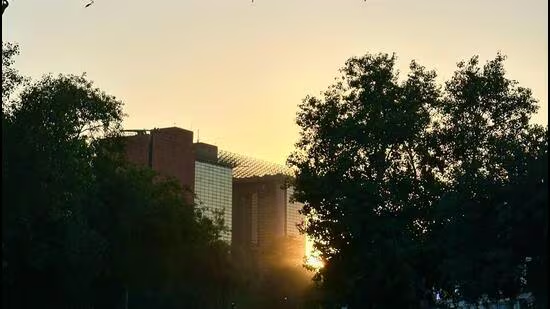
That’s a Charles Correa. The Connaught Place edifice, Jeevan Bharti, is gigantic, and the front facade looks like a dizzying complex network of grids. | Picture courtesy HT Photo
The late architect designed the capital’s many other noteworthy complexes as well–Tara Apartments, Crafts Museum, and the British Council.
In the first biography of Charles Correa, one of modern India’s greatest architects, Mustansir Dalvi showcases not just his visionary genius but also his zeal to improve the lives of the common man, particularly in Mumbai
An Illustration of Charles Correa. | Picture courtesy Doulurni Narayana, Nyogi Books
The average Joe. Early in Mustansir Dalvi’s engaging biography of Charles Correa, the reader is introduced to Joe, the working township protagonist in You and Your Neighbourhood, an animated film the iconic architect directed as his final Masters’ thesis at MIT. We are given a peek into the then-aspiring architect’s vision, where he backs the power of individual acts and public participation for greater civic good.
The renowned architect and urban planner Charles Correa’s work includes a long list of buildings that reflect the clients’ choices and perspectives. Correa, who passed away in 2015, brought ideas to life through his buildings in his 60-year career, creating a legacy.
Delegates launch Charles Correa’s biography, titled Citizen Charles, authored by architect Mustansir Dalvi. | Photo Credit: Special Arrangement
Describing buildings as “sculpture” that can be used for human occupation is rather uncommon, but that is what Charles Correa, architect and urban planner, succeeding in doing: he brought life to his structures.
The Charles Correa Foundation (CCF) announces the 2024-2025 cycle of the Research Fellowship, a residency program based in Fontainhas, Panaji, Goa.
Apply by 31 October 2024 for a year-long position opening November 2024 with the following qualifications:
Professional degree in Architecture.
Proficiency in using the following software – InDesign, Photoshop, Illustrator, Premiere Pro, AutoCAD + SketchUp, WordPress.
Academic Architectural Portfolio.
Essay – 500 words (max). Prompt: Of the many issues that Charles Correa engaged with in his career, write about one that speaks to your interests the most, and why?
Writing sample – from an earlier academic paper.
During the Fellowship, you will be required to:
Work on the documentation of drawings and photographs of Charles Correa’s built and unbuilt projects, sketches and essays.
Assist in creatively designing and scheduling of the events related to the activities of the Foundation.
Organise and work on outreach programs of the Foundation through publications, conferences, exhibitions and workshops.
Assist in work related to acquiring funding for projects or events related to the activities of the Foundation such as preparation of dockets, posters, invitations, etc.
Work on writing up about concerns and issues related to architecture and urbanism, and represent them through essays, blogs, etc.
Creatively communicate outputs and learnings from past and on-going projects to increase the Foundation’s engagement across various social media platforms and our website.
Make presentations on the Charles Correa Archives, on his philosophy and works, to keen visitors coming to the Foundation, ranging from travellers, student groups and professionals.
Assist in preparation of project proposals, surveys and documentation, mapping and analysis, graphics, essays and presentations related to the research project, including coordination with agencies (government or private) for permissions, status, fees, etc.
Fellows will receive a monthly stipend of ₹20,000/- as well as rent-free accommodation in an apartment leased by the Foundation.
Send in your application by filling out the Google form with the necessary attachments.
For any queries write to us at apply@charlescorreafoundation.org
‘There are no great men,’ said Stendhal apropos of Napoleon, ‘there are merely great events.’ And, one could perhaps go further and say that there are great issues. For we are only as big as the questions we address. And this, to my mind, is the central riveting fact of life for architects in the Third World. Not the size or value of the projects we are working on but the nature of the questions they raise — and that we must confront. A chance to grow – the abiding virtue of a place in the sun.
Charles Correa, A Place in the Sun (1983)
SPEAKERS –
Nondita Correa Mehrotra | The Conversations Continue: CCF and the Archives
Our first talk of the conference questions – How does one take forward the conversations – engaging with the ideas that for the most part were ahead of their time? What are an architect’s archives? Are they just the tangibles – the drawings, models, photographs, and writings? Or are there others? This presentation will highlight the work of the Charles Correa Foundation which focuses on extending the spirit of his ideas and continues the conversations.
William J. R. Curtis | Taking the Long View: Charles Correa in Historical Perspective (Keynote Address)
The talk attempts to overall assess the life and works of Charles Correa. While it is desirable to recreate each context and to reconstruct the anatomy of intentions and guiding ideas of Correa’s individual buildings, it is also necessary to see his work as a continuing experiment with guiding principles. With this as the key premise, the speaker touches upon various facets of Correa’s architecture and urbanism – his key design principles and influences, all while exploring a sort of mythological concept of ‘Indian identity.’
Kulbhushan Jain | Charles Correa: Meaning and Pertinence
With the aspirations for a post-independent modern India in the foreground, this talk focuses on the dual influence of modernity and traditional inheritance seen in Correa’s architecture. The speaker attempts to look at three museums/art centres designed by him namely Gandhi Smarak Sangrahalaya, Ahmedabad (1963), Bharat Bhavan, Bhopal (1982) and Jawahar Kala Kendra, Jaipur (1986).
Rahul Mehrotra | Charles Correa and his Idea of India
The lecture will examine the spectrum of Charles Correas project in the context of his idea of India. It will attempt to situate his vision in his understanding and response to the political conditions in which he practised as an architect, planner and most importantly as an activist. The projects that will be covered would include his institutional work, housing as well as ideas about urbanism and his theoretical suggestions for practitioners in India. That is to examine Charles Correa’s legacy for India and his contribution of articulating a clear agenda for architects in India. That is to theorise the everyday in productive ways for designers and construct a clear idea of India.
Discussant – Ranjit Hoskote
Session 02 – Volume Zero
It refers to what Louis Kahn meant when he spoke of ‘Volume Zero’. What Kahn would say to his students goes something like this: ‘I love English history; I love the bloodiness of it. I’ve got eight volumes which I enjoy reading.’ Then, after a pause, he would add, ‘Well, actually, I haven’t read all eight — I’ve read only Volume One…and even that, I haven’t read more than just the first few pages.’ And then, more fiercely, ‘Actually, I don’t think history started the way they say it did. I think it started before that. I want to read Volume Zero.’ And then he would finish with this truly extraordinary sentence: ‘Architecture is magnificent because it deals with the recessions of the mind…with that which is not yet said, and which is not yet made.’
Charles Correa, The Pietro Belluschi Lecture, MIT, Boston (1998)
SPEAKERS –
Mustansir Dalvi | Citizen Charles
This talk will focus on how Charles’s architecture and urbanism are rooted not in the flourishes of design or notions of legacy and posterity but more in being a citizen of a city, a country and the world. Very early in his career, he moved away from the enticing possibilities of materiality and universalism, away from the ubiquity of Corbusian international Modernism and more towards the appreciation of the socio-cultural situation of his countrymen. Both his successes and failures, his built and unbuilt work are testament to this political location, that an architect is a citizen first.
Malvika Singh | The Quintessential Polymath A True Renaissance Person
This talk outlines Correa’s influence with his comprehensive identity as an architect, public intellect and importantly, a humanist. Highlighting the synergy between Correa and his partner Monika as his other half, his ardhangini. They together injected the structures with the metaphors that marked their life. His architectural philosophy advocates for designs that respect local contexts while promoting sustainability. The talk asserts that his ethos lives on and is palpable in our everyday lives.
Rajnish Wattas | The View from Chandigarh
Charles Correa was and remains a colossus. His persona is etched on Chandigarh’s hearts and the béton brut concrete facades of Corbusier, whom he loved to rub the wrong way. This talk is a reversed telescopic view of Charles, as to how we saw him then and read his views on the city of Chandigarh along the lines of his brilliant article ‘The View from Benares’.
Tridip Suhrud | A Memorial for Mr Gandhi
A man who aspired to be a mendicant, whose striving was to attain a state of desire less, who eschewed statues and idols equally is assassinated and his associates embark on a mission to memorialize him. This conversation seeks to ask a question, what is a memorial to Gandhi? This will be done with the memorial at Sabarmati and the Gandhi Smarak Sanghrahalaya designed by Charles Correa.
Discussant – Ranjit Hoskote
Session 03 – Blessings of The Sky
The sky has always carried a profound and sacred meaning. Through some instinctive process, man has perceived it as the abode of the gods. Hence to climb a sacred path to the top of the hill, where the immortals dwell, is a paradigm of such mythic power that it has been central to the beliefs of almost every society, since the beginning of time. Such spaces have an infinite number of variations: one step out of a room…into a verandah…and then on to a terrace…from which one proceeds to an open courtyard, perhaps shaded by a tree…or by a large pergola overhead. True Enlightenment cannot be achieved within the closed box of a room – one must be outdoors, under the open sky.
Charles Correa, February, 1995 Part of the ‘CHARLES CORREA’ exhibition catalogue held in BORUSAN Art Gallery, Istanbul, May 22 – June 24, 2000
SPEAKERS –
Catherine Desai | First works: Charles Correa in Gujarat
This talk focuses on the early phase of Correa’s career in Gujarat, among the first five constructed projects, four were built in Ahmedabad or surrounding towns. Examining both his seminal and less often discussed buildings, we see that far from being hesitant beginnings or false starts for mature work to come, they are powerful, diverse and sophisticated statements of architectural intent, that remain of relevance to contemporary practice. What might an analysis of these first buildings, overshadowed by more famous works, reveal?
Liane Lefaivre | Charles Correa and Regionalism of the Global South
Talking about the architect and planner Charles Correa within the rise of regionalism as a major movement following WWII in the Global North and the Global South. Highlighting how Correa distinguished himself from many Northern architects by addressing environmental concerns in his designs. He experimented with more efficient techniques adapted from his early mentor and life-long friend Buckminster Fuller. Also discuss how Charles became committed to the idea of large-scale top-down planning, exemplified in projects like Navi Mumbai and lastly see how his towering contribution only gets more relevant with time in this present era of horrendous climate change and wretched poverty and homelessness.
Ranjit Hoskote | Charles Correa’s Approach to the Sacred Everyday
Charles Correa’s lifelong preoccupation with the sacred – not as a counterpoint to normal experience, but as a current within the every day – has remained under-regarded in the study of his vision and oeuvre. This talk will reflect on the interplay between inquiry and wonderment, and the hope of cosmic belonging, which animate many of Correa’s projects, including Salvacao Church in Mumbai, IUCAA in Pune, the Jawahar Kala Kendra in Jaipur, and the 1986-87 exhibition project ‘Vistara’.
Discussant – Mustansir Dalvi
Session 04 – Buildings As Ideas
For architecture is not created in a vacuum. It is the compulsive expression of beliefs (implicit or explicit) central to our lives.
Vistara, The Architecture of India (1986)
SPEAKERS –
Pradeep Dalal | Like the shade of a great tree: Howard Hodgkin’s Mural for the British Council Library in New Delhi, 1987-92.
Many of the buildings designed by the architect Charles Correa from the 1980s onward feature visual art as a significant aspect of the architecture. This talk will focus on the collaboration with the artists such as Janghar Singh Shyam who was commissioned to paint the shell domes of the Bharat Bhavan and walls of the courtyard at the Vidhan Bhavan, Bhopal. He also worked with the artist Howard Hodgkin to produce an immense mural for the façade that the artist later described as an “ecumenical tree of no particular species and no specific symbolism.” For both Correa’s architecture and Hodgkin’s mural, this collaboration was “the product of an infinitely refined imagination in the face of nature.”
Kaiwan Mehta | Humility and Multiplicity – Architecture’s Tryst with Indianness
The talk will build a conversation on two buildings by Charles Correa – the Gandhi Smarak Sangrahalaya at Sabarmati Ashram, in Ahmedabad, and the Jawahar Kala Kendra in Jaipur. The Sangrahalaya exemplifies humility in architecture, reflecting Gandhi’s core value- the self is public, and the public is not out of the self. Its simplicity and structure foster introspection and connection. In contrast, the Jawahar Kala Kendra represents multiplicity and creative expression, embodying Nehru’s vision of ‘unity in diversity’ and emphasizing the enjoyment of knowledge and not being trapped in myopic traditions. Correa captured a nation, in a tryst with its destiny – the difficulties and pleasures of being Charles Correa in India.
Sunil Shelar | The Ritualistic Pathway – 3 projects with different topologies
Since the earliest civilization, the ritualistic pathway was, and is, the central aspect of life on the subcontinent. Planetary positions held great importance and meaning in planning a building or a city. This talk will focus on how Charles Correa was fascinated by this knowledge and its significance regarding the design and organisation of buildings. The 3 buildings here are different in terms of their function, yet the ritualistic pathway, the climate, and the quintessential square remain central to their genesis.
Ashok Vajpeyi | A Home of Arts as a Non-building
This talk will be about Bharat Bhavan, a multi-arts centre in Bhopal designed by Charles Correa, to come up at a place that almost joined the old city to the new city. He called it a non-building since the whole building could not be seen in its entirety from anywhere. The presentation would trace the Correan aesthetics, imagination, and the multiple artistic uses many spaces could provide for and gently provoke.
Ajit Kembhavi | Architecture, Astronomy and the Cosmos: From Conversations to a Masterpiece
In his talk, he will recount the heady days when the ideas were first conceived in Mumbai and Bengaluru, the twists and turns through which the project of the Inter-University Centre for Astronomy and Astrophysics (IUCAA) progressed in Pune, the eventual completion, and the additions which have been made to the buildings from time to time, all in coherence with the original conception. He will end by summarising the progress of the IUCAA 2.0 building, which is now under construction and is probably the last design by Charles Correa.
Discussant – Rajnish Wattas
Session 05 – An Urban Manifesto
“For the city which we experience is, of course, much more than just a physical plant – it is also a set of powerful mythic images and values…that give sustenance, and enrichment to our lives. This, in the final analysis, is what cities are about. What culture is about. And what, hopefully, urban centres will once again become.”
Charles Correa, The City as: City, Housing and Urbanisation (1999)
SPEAKERS –
Vidyadhar Phatak | Charles Correa – An Urbanist
Though committed to his architectural practice, Charles Correa made significant contributions to urban development in India. Notable of these are the planning of Navi Mumbai, policy initiatives of MMRDA, National Commission on Urbanisation, Delhi Arts Commission, and Regional Plan of Goa. In this talk, the speaker intends to present his understanding and interpretation of Correa’s thinking about three themes viz. Indian Urbanisation, Urban Structures and Role of Land, Markets and Governance in shaping cities.
Jagan Shah | The National Commission on Urbanization: An Unfinished Project for Modern India
Through his talk, Jagan Shah will highlight the quality of the NCU’s contribution to modern India’s urban history. In stark contrast with more recent attempts at national policymaking, the NCU is overt in its affirmation of constitutional values, social justice, and equitable growth, which is a testament to the deep influence wielded by its Chairman, Charles Correa. The talk correlates the NCU’s work with Correa’s writings and with contemporaneous events such as the planning of Navi Mumbai to argue that the 1980s were a decade of tremendous progress on the urban policy as a lever for livelihood creation and poverty alleviation and that the progress has been subverted by the forces of globalisation and neoliberalism that have dominated policy discourse over the past three decades. The talk will conclude with reflections on the guiding principles of the NCU and their continued relevance for the future of India’s cities.
Discussant – Rahul Mehrotra
Session 06 – Space As A Resource
SPEAKERS –
Rohan Varma | The Bill of Rights for Housing in the Third World: Charles Correa’s Manifesto for Housing the Masses
This talk de-centres and expands this debate on habitat beyond its typically limited geography and timeframe by focusing on its development through an understudied manifesto written from the context of the Global South: Charles Correa’s 1985 ‘Bill of Rights for Housing in the Third World’. It also makes a case for revisiting Correa’s work and writings that advocate for an approach to housing that blurs the dichotomies between the formal and informal and top-down and bottom-up practices. Dirk Van Gameren | Housing Lessons Charles Correa’s patient search for a habitat for all
A remarkable part of Charles Correa’s built, and unbuilt work are his projects for housing. His ‘recherche patiente’ is arguably one of the main contributions in our times to that most crucial challenge for both architects and urban planners: to address the continuing demand for good, accessible and affordable housing. The talk will focus on this long and patient search for optimal models for housing. Different lenses will explore how to understand his thinking and designing, looking from the way the built form shapes public and collective spaces, the inclusion of open space in the private realm of the dwelling, to how material structure and detail emphasise the climatic and functional experience of space in and outside the individual dwelling.
Rohan Shivkumar | Lovely Villa: A film on growing up in Charles Correa’s LIC Colony
Every house is haunted by the spirits of those are yet to come, and of those that came before. We are all marked by the architecture of the homes we live in. ‘Lovely Villa’ is the name of the apartment building where the filmmaker grew up, as he studied to become an architect. It is in the LIC colony designed by Charles Correa and represents an imagination of the ideal community for a modern India. This is a film about the relationship between architecture, everyday life, family, coming of age and the memory of ‘home’.
Director, Charles Correa Foundation, Principal, RMA Architects
Panjim/Mumbai/Boston
Nondita Correa Mehrotra is Director of the Charles Correa Foundation and practices in India and the United States. She studied architecture at the University of Michigan and at Harvard’s Graduate School of Design and worked for over two decades with Charles Correa. She is a principal in the firm RMA Architects Mumbai + Boston. She has incorporated an active academic life into her career as well, teaching studios at the University of Michigan and at MIT and is currently teaching at RISD. Augmenting her teaching, several of her essays have been published in architectural books. She has been on numerous juries, including the Master Jury of the Aga Khan Award for Architecture; the Lafarge-Holcim Awards Jury in 2020; and the 2023 AIA NY Design Awards. She is also an External Design Advisor to the Harvard Allston Land Company, a peer review process for Harvard University’s new campus. Mehrotra was among 5 finalists for the design of the symbol for the Indian Rupee, an idea she had initiated with the Reserve Bank of India in 2005.
William Curtis
Architectural Historian, Critic
Cajarc
William J. R. Curtis is an award-winning historian, critic, painter and photographer. He has taught at many universities including Harvard, the A.A. London, and Cambridge where he was Slade Professor of Fine Art. Curtis’s best-known books are Modern Architecture Since 1900 and Le Corbusier: Ideas and Forms, both referred to as ‘classics’. He has written extensively on architecture ancient and modern on the Sub-Continent, including Le Corbusier, Louis Kahn, Muzharul Islam, a monograph on Raj Rewal,(1986, Om Books, 2024), the seminal text ‘Towards and Authentic Regionalism’(1986) Archnet > Publication > Towards an Authentic Regionalism and the award winning monograph Balkrishna Doshi: an Architecture for India (1988). Curtis has received numerous awards, among others: The Tau Sigma Delta National Honor Society Gold Medal in Architecture and Allied Arts, USA (1999); and the Golden Award for Global Contribution in Architecture (CERA, A+D, India, 2014), in recognition of his defence of modern architectural heritage in India.
Kulbhushan Jain
Emeritus Professor, CEPT University
Ahmedabad
Kulbhushan Jain, architect-urbanist and conservation consultant studied and worked with Louis Kahn. He taught at CEPT University, Ahmedabad, for more than four decades and held various positions including Director, School of Architecture, and Chairman, Doctoral Programme. He has been visiting professor at MIT, Cambridge, USA; UBC, Vancouver, Canada and POLEMI, Milano. He has worked as consultant to NID, Ahmedabad; INTACH, New Delhi and MMT, Jodhpur. Jain has published several books, articles and conference papers. He has been a member of several juries for national and international design competitions.Jain’s major conservation projects include Mehrangarh Fort (1990-2023) with Museum design, Jodhpur; Fort of Nagaur (1990-2023) including rehabilitation of Ranvas; Jaisalmer Fort (1985-2005) including restoration of Rani ka Mahal and Amber Fort (2005-2010) including comprehensive planning, Jaipur.
Rahul Mehrotra
Founder Principal, RMA Architects, Professor, Harvard University
Mumbai/Boston
Rahul Mehrotra is the founder principal of RMA Architects and the John T. Dunlop Professor in Housing and Urbanization at the Graduate School of Design at Harvard University. Mehrotra’s most recent books are titled Working in Mumbai (2020) and The Kinetic City and other essays (2021). The former is a reflection on his practice, evolved through its association with the city of Bombay/Mumbai. The second book presents Mehrotra’s writings over the last thirty years and illustrates his long-term engagement with, and analysis of, urbanism in India. This work has given rise to a new conceptualization of the city which Mehrotra calls the Kinetic City.
Mustansir Dalvi
Poet, Editor, Academician, Professor, Sir JJ School of Architecture (retd)
Mumbai
Mustansir Dalvi is Professor of Architecture at Sir JJ College of Architecture (retired). He is on the Board of Governors of the MMR-Heritage Conservation Society and a Trustee of Art Deco Mumbai. Dalvi holds degrees in architecture and a diploma in Indian Aesthetics from the University of Mumbai. He received his PhD from the Indian Institute of Technology-Bombay. He is the author of The Romance of Red Stone: An Appreciation of Ornament on Islamic Architecture in India (2011) and The Past as Present: Pedagogical Practices in Architecture at the Bombay School of Art (2016). Dalvi is the editor of 20th Century Compulsions (Marg, 2016), a collection of writings about early Indian modernist architecture. His latest book, Citizen Charles: a biography Charles Correa, by Niyogi Books, is scheduled to be published in October 2024.
Malvika Singh
Author & Publisher, Seminar
New Delhi
Publisher of Seminar, a prestigious monthly magazine of ideas and alternatives, founded in 1959. Author of Perpetual City: A Short Biography of Delhi. Author of Bhutan: Through the Lens of the King, New Delhi: Making of a Capital, Delhi: India in One City, Snowdon’s India, portraits of 100 celebrated Indians – images by Lord Snowdon. She has worked as Editor for various books. She is a Trustee of the Ranthambhore Foundation and Founding member of Rehwa Society, working to revive the Maheshwari sari in India. She also has extensive experience as a journalist both in the print media as well as in films and television. She has served on multiple advisory boards of the Ministry of Culture, Government of India; designed and produced products for The National Museum Shop, New Delhi. Served on the board of the National Culture Fund. Government of India. Served as a member of the Board of Trustees, India Brand Equity Foundation. She was Member of the Advisory Board of the Chief Minister of Rajasthan for one term spanning five years, and was responsible for art, culture and for the redefinition of the state’s tourism policy. Malvika was decorated as a DAME in the civil merit honours list of the King of Spain, 2009. She is Consulting Editor to LIMITED EDITIONS, an imprint of Academic Foundation. She has edited a series of social histories written by professionals with an extraordinary story to tell, and also by extraordinary people sharing their personal stories.
Rajnish Wattas
Principal Chandigarh College of Architecture (retd)
Chandigarh
Rajnish Wattas, former principal of the Chandigarh College of Architecture is an architectural critic and modern architectural and landscape heritage expert. He has authored a huge compendium of professional writings and published hundreds of essays, travelogues and features in leading journals and newspapers. He is co-author of two books Trees of Chandigarh and Sukhna — Sublime Lake of Chandigarh and co-editor of ‘LE CORBUSIER REDISCOVERD: Chandigarh and Beyond. Has lectured at prestigious forums including Graduate School of Design, Harvard University, the American Institute of Architects and Illinois Institute of Technology IIT, Chicago among others. On various expert groups, he evolved the ‘Master Plan of Chandigarh – 2031’ as a team member and presently a member of the ‘Chandigarh Heritage Conservation Committee’ and Governor’s Advisory Council. He is co-founder of the ‘Chandigarh Tree Lovers’ and an acclaimed photographer with photo exhibitions and photo essays to his credit.
Tridip Suhrud
Professor & Provost, CEPT University
Ahmedabad
Dr. Tridip Suhrud is a Professor and Provost of CEPT University, Ahmedabad. He is also a Director of Lalbhai Dalpatbhai Institute of Indology, Ahmedabad and serves as Chairman of the Governing Council of MICA. His recent works include the critical editions of M K Gandhi’s Hind Swaraj and the Autobiography, a two-volume project on editing and translating the diary of Manu Gandhi (one part published), has translated into English the canonical Gujarati novel Sarasvatichandra and is currently working on a possible nine volume project, Thumb Printed (three volumes published) on the testimonies of indigo cultivators of Champaran.
Catherine Desai
Architectural Historian, CEPT University
Ahmedabad
Catherine Outram Desai is an architect in research-based practice. She is an Adjunct Assistant Professor at CEPT University where she teaches undergraduate and master’s programs in architectural design and history & theory. Her books include The Architecture of Hasmukh C. Patel and the forthcoming texts In-between Histories: Reading Indian Modern Buildings and Complete Works of Hema Sankalia. Her current academic research opens and reconsiders narratives of Indian architectural modernity through large-scale drawings and analysis of historic buildings and landscapes. She is a founding member of Ahmedabad Commons, a collective that opens buildings for public visits and debates issues of conservation and access to the city.
Liane Lefaivre
Architectural Historian, Critic
Paris
Liane Lefaivre is Professor and Chair of Architectural History and Theory at the University of Applied Arts in Vienna (retired). She and Alexander Tzonis have been writing about global regionalism since the early 1980s when they coined the term “critical regionalism,” a concept often misconstrued. Among their books on the subject are Architecture in Europe (Thames and Hudson 1993, Architecture in North America ( Thames and Hudson, 1995), Tropical Architecture, Critical Regionalism in the Age of Globalization ( Wiley, 2001), Critical Regionalism (Prestel, 2003 ), Regionalism in a Globalized World (Routledge, 2011). Among her recent publications are Rebel Modernists. Viennese Architecture since Otto Wagner (Lund Humphries, 2017) and, with Alexander Tzonis, a collection of their articles since the 1960s entitled Times of Creative Destruction. Architecture and the City in the 20C (Routledge, 2018) and an expanded edition of Regionalism in a Globalized World (Routledge, 2020) which is being updated and published in French (Parenthèses, 2025).
Ranjit Hoskote
Poet, Cultural Theorist & Curator
Mumbai
Ranjit Hoskote is a poet, translator, cultural theorist and curator. His collections of poetry include Central Time (Penguin, 2014), Jonahwhale (Penguin, 2018; in the UK by Arc as The Atlas of Lost Beliefs), Hunchprose (Penguin, 2021) and Icelight (Wesleyan University Press, 2023). Hoskote is the author of more than thirty books, including the acclaimed translation of a 14th-century Kashmiri woman mystic’s compositions, I, Lalla: The Poems of Lal Ded (Penguin, 2011) and, a translation of the 18th-century Urdu poet, Mir Taqi Mir, The Homeland’s an Ocean (Penguin Classics, 2024). In 2011, Hoskote curated India’s first-ever national pavilion at the Venice Biennale. With Rahul Mehrotra and Kaiwan Mehta, he co-curated the exhibition, ‘The State of Architecture: Practices and Processes in India’ (NGMA, Mumbai, 2016). He has been a Fellow of the International Writing Program, University of Iowa, and researcher-in-residence at BAK/ basis voor actuele kunst, Utrecht.
Pradeep Dalal
Artist/Architect, Director, Andy Warhol Foundation Arts Writers Grant
New York
Pradeep Dalal is an artist and writer based between New York and Mumbai. His work has been shown at venues including Hallwalls Contemporary Art Center, Oakville Galleries, Sala Diaz, Art Cake, EFA Project Space, Callicoon Fine Arts, and Murray Guy. His photographs have been featured in publications including Blind Spot, BOMB, Cabinet, Grey Room, Nueva Luz, and Rethinking Marxism. With Fia Backström, he co-authored Photography in the Sensorium (Dancing Foxes Press, 2021). His artist book Bhopal, MP was excerpted in Chandigarh is in India (The Shoestring Publisher, 2016). Dalal studied architecture at CEPT University and at MIT and worked on the design of the British Council Library in Charles Correa Associates in the late 1980s. From 2015 to 2020, Dalal co-chaired the Photography Department in the MFA program at Bard College. At present, he is Director of the Andy Warhol Foundation Arts Writers Grant.
Kaiwan Mehta
Architectural Critic
Mumbai
Born in Mumbai, Kaiwan Mehta is a theorist and critic in the fields of visual culture, architecture, and city studies. He is completing his doctorate at the Centre for the Study of Culture and Society, Bengaluru, under the aegis of Manipal University; and has now published as well as exhibited his research work and ideas internationally. He authored Alice in Bhuleshwar: Navigating a Mumbai Neighbourhood (Yoda Press. New Delhi, 2009). Since March 2012 he has been the Managing Editor of Domus India (Spenta Multimedia) and writes prolifically on architecture, aesthetics, and cities. He has been elected as the Jury Chairman for two consecutive terms (2015–17 and 2017–2019) for the international artists’ residency programme across 11 disciplines at the Akademie Schloss Solitude in Stuttgart, Germany. Mehta recently co-curated the national exhibition on architecture with Rahul Mehrotra and Ranjit Hoskote – “The State of Architecture: Practices and Processes in India” (UDRI, 2016) at the NGMA, Mumbai. He has authored the book The Architecture of I M Kadri (Niyogi. New Delhi, 2016). He is currently the Dean of Balwant Sheth School of Architecture, SVKM’s NMIMS (deemed to be) University.
Sunil Shelar
Principal, Sunil Shelar Architects
Bangalore
Since the earliest civilization, the ritualistic pathway was, and is, the central aspect of life on the subcontinent. Planetary positions held great importance and meaning in planning a building or a city. Charles Correa was fascinated by this knowledge and its significance with reference to the design and organisation of buildings. In his introduction to the Vistara exhibition, he underscores the fact that as vistaras (expansion of knowledge) happen, the central aspect gets richer and more meaningful. The 3 buildings here are different in terms of their function, yet the ritualistic pathway, the climate, and the quintessential square remain central to their genesis.
Ashok Vajpeyi
Poet, Literary- Cultural Critic
New Delhi
Ashok Vajpeyi, a Hindi poet-critic, translator, editor and culture-activist, is a major cultural figure of India. With more than 30 books of poetry, criticism in Hindi English to his credit, he is widely recognised as an outstanding promoter of culture and an innovative institution-builder. He has organised more than a thousand events to his credit relating to literature, music, dances, theatre, visual arts, folk and tribal arts, cinema etc. He has been awarded the Sahitya Akademi Award, the Dayawati Kavi Shekhar Samman, Kabir Samman, Shakti Chattopadhyay Puraskar, K Ramakrishnan Award etc and awarded D.Lit. by the Central University of Hyderabad and ITM University. Also, he has been decorated by Poland with the outstanding national award ‘The Officer’s Cross of Merit of the Republic of Poland’ and the French Govt. by the award of ‘Officier De L’Ordre des Arts Et Des Lettres’. He set up the renowned Bharat Bhavan in Bhopal; has been the first Vice-Chancellor of Mahatma Gandhi International Hindi University and Chairman, Lalit Kala Akademi. A retired civil servant, now the Managing Trustee of the Raza Foundation.
Ajit Kembhavi
Astrophysicist, Founding Member, IUCAA
Pune
Professor Ajit Kembhavi is an astronomer. He is Professor Emeritus at the Inter- University Centre for Astronomy and Astrophysics (IUCAA), Pune, where he was Director during 2009-2015. He was the Director there until August 2015. He is one of the founder members of IUCAA and played a major role in setting it up and developing it into a world-class institute. He did his Ph. D. from TIFR with Professor Jayant Narlikar. Kembhavi works on galaxies, quasars and other extragalactic objects, Big Data and the application of AI to astronomy, biology and chemistry. He has published a large number of research papers and several books in English and Marathi. Kembhavi is involved in many national and international collaborations and is one of the key persons responsible for India joining the Thirty Metre Telescope (TMT) project as a partner and taking up the LIGO India project. Kembhavi has been a member of the Space Commission and is a member of ISRO Apex Science Board. He was Vice-President of the International Astronomical Union and former President of the Astronomical Society of India. He is a Fellow of the Indian Academy of Sciences and the National Academy of Sciences, India.
Vidyadhar K Phatak
Dean, Faculty of Planning, CEPT University (retd)
Mumbai
Vidyadhar Phatak worked in various public organisations such as CIDCO and MMRDA for 37 years till 2004. During this period, he had an opportunity to work with Charles Correa on New Bombay, and policy development for housing and regional structure of MMR. He was a member of National Commission on Urbanisation (1988) and a Study Group on ‘Cotton Textile Mills in Mumbai’ (1995). Charles was the Chairman of Both. Thereafter till 2016 he worked as freelance consultant on various aspects of urban development. From 2016 to 2019 he was Dean, Faculty of Planning, CEPT University. His book on “Planning for India’s Urbanisation” was published by CEPT University Press in April, 2024.
Jagan Shah
CEO, the Infravision Foundation
New Delhi
Jagan Shah is CEO of The Infravision Foundation. His previous roles include Senior Adviser (Capacity Building) at The World Bank and Senior Infrastructure Adviser in the UK’s Department for International Development. As Director, National Institute of Urban Affairs, he co-created the Smart Cities Mission and incubated centres for digital governance, sanitation and climate adaptation. He has designed AfD’s ‘City Investments to Innovate Integrate and Sustain’ program and CDRI’s Infrastructure for Resilient Island States facility and led the preparation of the Draft Master Plan for Delhi 2041. Shah studied architectural design and history, theory & criticism in New Delhi, Cincinnati and New York. He is Adviser to My Liveable City and a Trustee of Clean Air Asia.
Rohan Varma
Lecturer & Researcher, TUDelft
Amsterdam/Mumbai
Rohan Varma graduated as an architect from the University of Mumbai and worked for Charles Correa between 2008 and 2010 before receiving his master’s in architecture from the TU Delft as a Tata and Mahindra Scholar. He currently divides his time as the Principal Architect of VARMA Architects with his work at the TU Delft, where his doctoral research and teaching activities focus on affordable housing in the rapidly urbanising cities of the Global South. In 2018, he co-curated an international travelling exhibition on the housing designs of Charles Correa. More recently, in 2020, he was appointed as a Delft Global Fellow, and in 2022, he, along with his colleagues at TU Delft, won the global edX Prize for the online course ‘Global Housing Design’. In 2023, he was appointed editor of the journal Delft Architecture Studies on Housing.
Dirk Van Gameren
Dean, Faculty of Architecture, TUDelft, Partner, Mecanoo Architecten
Delft
Dirk van Gameren is a professor of housing design and dean of the Faculty of Architecture and the Built Environment at Delft University of Technology, and partner at Mecanoo Architecten. At TU Delft, he leads the Global Housing Study Centre that focuses on the issues related to designing and building affordable housing in the rapidly expanding cities of the Global South. Dirk van Gameren is founding editor of the DASH Delft Architectural Studies on Housing book series. He curated in 2018 the exhibition Living Ideals, designs for housing by Charles Correa that has been travelling to various cities in India. In autumn 2022 his study Dutch Dwellings, the architecture of housing, was published by Park Books.
Rohan Shivkumar
Dean of Architecture, KRVIA
Mumbai
Rohan Shivkumar is an architect, urban designer and filmmaker practising in Mumbai. He is the Dean of the Architecture at the KRVIA, Mumbai. He is interested in exploring different ways of reading and representing the city. His work ranges from architecture, urban research and consultancy projects to works in film and visual art. His research includes projects in Dharavi, the National Park, and the spaces of Dr Ambedkar in Mumbai. Rohans’ work in film includes the interdisciplinary research and art collaboration ‘Project Cinema City’. He also curates film programmes and writes on cinema, architecture and urban issues. His films include ’Nostalgia for the Future’, ‘Lovely Villa’, and ‘Squeeze Lime in Your Eye’. His work has been featured in many events including the Chicago Architecture Biennale, the Sharjah Architecture Triennale, the Seoul Architecture Biennale, the World Social Forum, the Dhaka Art Fair and Documenta.
A photo essay exploring Correa’s collaborative projects with artists, highlighting how murals integrate with his architecture.
As a contemporary architect, Correa’s architecture is infused with various forms of art. One such relationship is between his architecture and mural paintings. “It started first when we moved into CCA office. We didn’t know what to do with a protruding column. The usual thing is to hide it in a cupboard or perhaps make a false ceiling, but then we thought it seemed like a tree so why not celebrate it and paint it like a tree? That is what we did and this experience we carried over to other projects.” Correa always believed that architecture must address issues beyond the purely empirical and functional, and instead tackle meaning and symbolism in new and profound ways.
Charles Correa overseeing the Mural by Bhiwandkar at IUCAA, Pune Photo: copyright, Charles Correa Associates, courtesy Charles Correa Foundation
“My name is Marty Chen. I taught policy at the Harvard Kennedy School for 35 years and co-founded the WIEGO network which seeks to empower the working poor in the informal economy around the world to secure their livelihoods. Before joining Harvard University, Iworked in Bangladesh in the 1970s and India in the 1980s with NGOs seeking to empower the working poor in villages and cities.
In 2020, I was asked by Nondita Mehrotra to chair the jury for that year’s Nagari Short Film competition. The topic for that year’s films – “people and livelihoods in urban India” – was a topic that is central to my work and dear to my heart. So, I readily agreed. There were five of us on the jury – an art critic and poet, a lawyer and judge, two filmmakers and an activist academic. The jury jointly viewed the nine films – then discussed the films at some length, sharing our different perspectives, and then voted on the films. It was a difficult task to rank the films – as each was strong in different ways.
All of the films in the competition were powerful – telling the story of the barriers faced by the working poor in trying to earn a living in urban India: barriers that range from social discrimination and prejudice to lack of urban services. sanitation and governance to climate change to corporate collusion with politicians and government and to the COVID pandemic recession. The films featured a range of urban occupations: food vending, fast food delivery, liquor-making, fishing, water chestnut harvesting, tailoring, construction day labour, and migrant workers in a yarn recycling facility, at a stone quarry and in floating casinos. One film also featured the aspirations of two children of the working poor – to study for a PhD and to perform as a break dancer.
Having worked on the livelihood challenges of poor households in India and South Asia for four decades, I was deeply moved and impressed by how the young filmmakers, who were new to the subject, were able to capture the barriers the working poor face in pursuing their livelihoods but also their dignity, expertise and resilience. To paraphrase the adage, “a short film is worth 10,000 words”. My hope is that the Nagari Short Film competition will continue to document core issues of urban India – as short films are an excellent medium for communicating challenging urban issues through the lens of those who have to deal with them on an everyday basis.”
“The Nagari Short Film Competition has been a wonderfully generative space since its inception in 2020. It has facilitated the production of a large number of short documentary films by young people that are crucial to understanding urban dynamics and crises in the Indian context. Its focus on voices from the margins gives visibility to perspectives that are often not considered by urban planners and policymakers. From housing, to livelihoods, to water and waste management, it has created valuable and timely content. This initiative is truly worthy of support and encouragement, for both the process and the product make an important contribution to the conversations around urban planning, development and the rights of citizens.”
“I was a Nagari short film festival jury panellist in 2022 and can attest that the short films made by young filmmakers in this Charles Correa Foundation (CCF) competition address key issues of our times in creative and enlightening ways. In 2022, the theme was water and urban spaces. I learned so much about Mumbai’s water system through the story of one man’s impossible journey to get a legal water connection in his community-the urban settlement of Siddharth Nagar in Mumbai, and another young woman’s story about the challenge of living with rainwater streaming into her community from an adjacent and huge garbage dump on the outskirts of a large urban metropolis. Nagari is a unique film platform– it showcases hidden stories about the lived experience of people in diverse conditions of different cities–and should be supported to continue to raise awareness of and trigger solutions to the challenges of rapid and massive urbanisation.”
CCF write to KA regarding concerns over alteration of architectural finishes. Requests for transparency of work being carried out. Request to be involved in the repair.
CCF organise meeting with Techton Buildcon Pvt Ltd
CCF inform the consultant in a public meeting that no aesthetic changes are to be carried out to Kala Academy. Techton point out the waterproofing and accoustic issues in the structure. CCF and local historians explain the 1983 design and the changes made in 2004. Request Techton to revert to finshes and accoustics of 1983.
CCF inform the court that our demand to persue repair, has been accepted by the govt. Court judgement states that “no structures in the Kala Academy complex will be demolished, but structural repairs and renovation works will be carried out for preservation and maintainance of the complex.” First time a 20th Century building has been saved from demolition by a Court Order
1 July 2021
Techton appoint a team to start work.
24 June 2021
Government appeal to the High Court to dismiss the petition
Amicus Curiae requests CCF to review the government proposal and verify that there will be no demolition of Kala Academy before disposing the case. Granted, till 8 July 2021
Work given without tender. Sum of 39.63 Crore + tax.
30 December 2020
Request from CCF to KA regarding update on repair of KA & for a site visit. No reply from KA.
7 June 2020
Onset of the South-west monsoons in Goa
KA remains exposed and it gets inundated with water
25 March 2020
Janta Curfew and start of nation-wide lockdown
CCF heard, unofficially, that the state is broke and no funds are available for Kala Academy
16 March 2020
Court Hearing
Postponed indefinitely due to COVID 19
CCF submit an affidavit in absentia, putting a timeline and explaining the recommendations of Dr. RG Pillai, the affidavit also demanded that the non-performing waterproofing be scraped off before the monsoons as it soaks water like a sponge and contributes to the dead load. .
10 March 2020
Getty Foundation asks for details
Getty wrote back asking for further clarification and details.
4 March 2020
Getty acknowledgement of receival
Getty acknowledged receipt of the application
3 March 2020
Keeping it Modern grant by Getty Foundation
Keeping it Modern grant by Getty foundation was applied to for funds.
2 March 2020
Court Hearing and meeting with Gaude
Deputy AG requested postponing the hearing citing absence of AG.
Nondita Correa Mehrotra and Tahir Noronha’s meeting with Gaude requesting a letter of consent from Kala Academy with the idea of accepting private/CSR funds to pay consultants, to ease taxpayer’s money. The minister puts it on member secretary Kala Academy who stated that such proposal would not be accepted.
In the meeting, it was informed that the Goa State Infrastructure Development Corporation (GSIDC) will not take up any work in Kala Academy since they only take work valued over 10Cr.
Kala Academy has approached PWD but have got no response. Next court hearing on 16th march 2020
20 February 2020
CCf send a letter to Kala Academy to appoint consultants
Letter from CCF to Kala Academy with the subject of appointing consultants for repair attaching the report and proposal, CVs of Arun Mennon and Dr.R.G. Pillai and profile of NCSHS.
Since NCSHS and IIT Madras are fully funded Government of India institutions, there is no need to call for tenders by the state.
19 February 2020
Report from Dr. R.G. Pillai and proposal from NCSHS
Report from IIT madras i.e. Dr. R.G. Pillai is received, based on his inspection and peer review.
Another document from NCSHS is received with proposal to take up the case of Kala academy as consultants at the cost of 15 lakhs INR.
18 February 2020
Preliminary recommendations from Dr. RG Pillai. Followed by basic repair strategy from IIT Madras.
30 January 2020
Article on Gaude’s press conference gets published
Accuses CCF of incompetency to put up a shed on Kala Academy’s amphitheatre
Claims that CCF has been objecting any repairs to Kala Academy since 2010 (i.e. before inception fo CCF)
27 January 2020
Court hearing
The AG placed the minutes before the hon. Judge and said that the government. Has taken objection to points made by Kala Academy in the minutes. Points raised:
How can NCSHS be appointed without tender?
Justice Sonak said since it is an institution fully funded by the Government of India. Additionally they will only be doing consultant work and not implementation. Hence there should be no objection.
AG said the Finance Department and the Ministry of Art and Culture should also agree – to which the judge said, get the approvals in 3 weeks.
AG was saying CCF is just going after the glory, to which the judge reprimanded him and reminded him to not treat this as adversarial litigation.
Judge has requested the government to follow the calendar put down in the minutes and not delay any further.
Case is adjourned to 5th March. The government is requested to complete all financial and administrative approval for appointment of IIT Madras before that.
Inspection by Dr. R.G. Pillai alongwith Dr. K.G. Guptha HOD Civil eng. (GEC), Arminio Ribeiro and Tahir Noronha (CCF) , Gaurish Bhagat (JE Kala Academy) and Gurudas P.Pilarnekar (director, art and culture)
Minutes of the meeting important points:
Dr Pillai stated that the structure does not require demolition and can be repaired. Quality of work should not be compromised by rushed time-schedule. It is advisable to ensure long-term preventive measures to preserve the building.
Dr. K.G. Guptha HOD, Civil Eng., Goa Engineering College (GEC) stated that no more water should be allowed to enter the structure, nor flow along the amphitheatre as it seeps and damages the concrete.
Member Secretary Mr. Gurudas Pilarnekar resolved that by the end of February 2020 he would get the necessary administrative and financial approvals to cover the structure and not let any water enter.
Dr. KG Guptha, explained some complications that will arise during the covering of the structure due to the slab aready being overloaded by multiple layers of non-performing waterproofing.
The Charles Correa Foundation may not be able to provide solutions to these complex issues alone, as our expertise is limited to the field of Architecture.
10 January 2020
Kala Academy invitation for stakeholder’s meeting with Pillai
Letter from Kala Academy acknowledging the letter from CCF, inviting all stakeholders to participate in the inspection by Dr. R.G. Pillai, as well as informing about a stakeholder meeting on the same day i.e. after the inspection.
3 January 2020
CCF sends Kala Academy a letter with details of inspection
Mentioning three thing to Kala Academy from CCF:
NCSHS – IIT-Madras are conducting peer review of the audits as well as visiting the structure pro-bono.
CCF is bearing the cost for the conveyance.
Requesting Kala Academy to assist with arrangements for the inspection.
27 December 2019
Letter of request to allow inspection
Letter from CCF requesting Kala Academy that IIT Madras will come and conduct inspection on 16th January 2020.
20 December 2019
Response from IIT Madras
IIT Madras responded that Prof. R.G.Pillai can visit Goa on 16th January 2020 and conduct an inspection of the structure.
CCF paid for the conveyance of the recommended expert — Dr. Radhakrishna G. Pillai.
16 December 2019
Court Hearing
The pertinent points to note:
The government puts forward that in the meeting dated 2nd December 2019. It is decided to call in a structural expert who would suggest appropriate repair methodology, after studying both structural reports and visual observation.
They said they have not received any confirmation from the expert that they had reached out to.
They mentioned that they will be keeping CCF and GSIDC in the loop and will consider any suggestions/ recommendations from either agency and their expert panels as well.
Case is adjourned till 27th January.
5 December 2019
CCF approaches NCSHS
CCF approached the National Centre of Safety of Heritage Structures at IIT-Madras
4 December 2019
Kala Academy invites Dr. Kapuria
Member secretary of Kala Academy sends letter to the identified expert Dr. Kapuria, who does not respond.
2 December 2019
Stakeholder’s meeting
The pertinent points to note:
The minutes of the previous meeting were amended after discussion. Point (6) of the previous minutes now reflects the statement by Structural Auditor Dr. KG Guptha from GEC that “the structure can be saved and does not require demolition”.
The Kala Academy had requested GSIDC to take up auxiliary minor repair works (mostly cosmetic) and the mild moderate and severe structural issues still remain to be addressed. (2 & 6)
A decision was taken to call in an expert to advise on repair methodology before any decision is taken. An expert was identified by one of the stakeholders. (7 & 9)
28 November 2019
Letter from Kala Academy about GSIDC work and inviting for stakeholder’s meeting 2019
Letter from Kala academy stating GSIDC has carried out works of the Kala academy building as per pre-arrangements of IFFI 2019 and invites to stakeholders meeting on 2nd december 2019
18 November 2019
AG wishes to file another affidavit
AG claims in court that additional evidence has come up and he wants to file another affidavit explaining the same.
21 October 2019
Request from Government to include GSIDC
Government requests GSIDC (implementing agency) to be added to the case.
17 October 2019
CCF submits letter to Kala Academy
CCF submits a letter to Kala Academy stating no architectural changes should be made to the building.
CCF reccommends Kala Academy to bring in structural expert Dr. Arun Mennon from IIT Madras
CCF recommends changes to the minutes to the previous meeting.
There was an assurance from the Kala Academy Chairman (Minister Gaude) that the government will explore all options to strengthen the structure before taking a decision to demolish the structure.
The Minister and the Member Secretary requested CCF to come up with some design solutions to address the issues plaguing the structure – especially water seepage.
The Member Secretary requested unanimity among stakeholders for permission to conduct urgent repairs.
CCF had previously expressed no objection to imediate repairs of the areas marked as “SEVERE” in the structural reports.
CCF was granted access to inspect the structure only after the meeting ended.
24 September 2019
Invitation to stakeholder meeting by Kala Academy
Letter from the Member Secretary Kala Academy inviting CCF to a stakeholder meeting to discuss the structural safety audits conducted by GEC and GEM Engiserv.
With this letter CCF obtained copies of the GEC and GEM audits.
9 September 2019
CCF files an affidavit at the High court
CCF files an affidavit with inputs on the GEC report mentioning the 2004 renovations, at the cost of 24.9 crores, declaring the work to be unscientific and substandard (the cause of the present issues) and attaching letters from notable artists and members of civil societies.
Government seeks more time since the second report is delayed.
Advocate General informs GEM Engiserv from Navi Mumbai have been awarded the tender to undertake the second audit.
27 August 2019
Affidavit filed by the government
Government makes an affidavit attaching Goa Engineering College’s Report
Also declared that they will be getting second report and that as yet there is no decision to demolish the open air auditorium.
19 August 2019
Court hearing
The government and the court accept the intervention put forward by CCF. The government was requested to file an affidavit.
GEC submitted their report which consisted of all comprehensive data including NDT and inspections. KA need not be demolished & required structural strengthening.
19 September 2018
First proposal of needed step to be undertaken
GEC informs KALA with a proposal for NDT
30 July 2018
First structural inspection
GEC acknowledged the request and performed an inspection.
5 July 2018
First step for safety analysis and risk
Kala academy requested the local Engineering School (GEC) to conduct a structural safety audit.
8 June 2018
First official report of any structural safety risk
Umesh Kholkar complaint letter- part of the slab collapsed; later on it was found that it was the false ceiling that had collapsed.
15 December 2017
KA authorities request CCF views and suggestions w.r.t restoration & upgradation of KA.
May 2006
CAG points out finanicial irregularity in Kala Academy Work
Works tendered at 2 times the actual cost.
June 2005
Massive leakage observed in Kala Academy
Public outcry featured in all state newspapers. CM Pratapsinh Rane appoints Rajiv Shrikande to investigate claims.
September – December 2004
Changes to Kala Academy
Jain makes several changes to the finishes of the building. The waterproofing was once-again rushed in the same methodology as 1996. A new detail for protecting the expansion joint was developed. Accoustic Treatment of the Indoor Auditorium was completely changed on the advice of accoustic vendors, without any scientific input.
September 2004
Uttam Jain defends the changes
August 2004
No response from Uttam/Chirag Jain, Correa gets worried
Mentions the change of materials, use of granite and changing of the acoustics. Structural rehabilitation & waterproofing neglected.
5 May 2004
Correa met Chiraj Jain, agreed to advise them at no cost
Chirag also asked for the drawings, which Correa gave
30 April 2004
Letter from Cheif secretary explaining that they appointed Uttan Jain
Proposal is simply carry out internal repairs and refurbishments and nothing else. Seeking Correa’s approval to proceed.
17 Feb 2004
Parrikar Press Conference on Kala Academy on KA upgradation
Parrikar said that Correa was too busy with international commitements to take up the work, so they have appointed Uttam Jain for the rpoject, considering Chirag Jain’s experience at the CCA office.
10 July 2003
Kala Academy approach Correa for the up-gradation of Kala AcadLetter indicating that KA authorities would consult Mr Correa regarding changes in KA, however small.my
December 1996
Waterproofing work hurried
On account of the Monsoon and visit of the Prime Minister of India to Goa, the waterproofing work was rushed. Instead of removing the original waterproofing, a new layer was put over the old waterproofing.
April 1996
Seepage obseved
Seepage, primarily from the roof slabs. Correa advised the Kala Academy to appoint a local consultant to oversee the waterproofing. CEM India appointed for the work.
17 December 1987
Grouting and waterproofing stopped prematurely
On account of visit of President of India.
16 February 1987
Grouting work started
11 November 1986
Seepage obseved
Seepage from the floor of the indoor auditiorium (through the chair-fitting), the control room of the Open-air Amphitheatre, and through the expansion joints in the roof-slabs.
9 September 1986
N B Hadker’s letter identifying design & supervision by CPWD being cause of leakages at KA.
11 November 1983
Kala Akademi building handed over to the Kala Academy Society
13 March 1983
The raft foundation designed by Central PWD, New Delhi, failed due to up-thrust from ground-water. NB Hadkar appointed on Correa’s advice, designs new slab.
With the rise in transport infrastructure projects, in the name of nation-building, the informal economies continue to bear the brunt of ‘public purpose’ projects.
“Internal displacement is the great tragedy of our time. The internally displaced people are among the most vulnerable of the human family” – Kofi Annan, former UN Secretary General
For decades, India has been experiencing immense pressure on its transport infrastructure to meet the growing demand of its population. The aggressive approach to transport infrastructure development coupled with a lack of sustainable urbanisation policies has resulted in issues such as congestion pollution, overcrowding and accidents while also excluding accessibility for the economically weaker sections, women and disabled people. One of the major consequences of the rather disorderly and haphazard construction of such transport infrastructures, and which is the subject of discussion here, is the displacement of communities, particularly of the informal economies.
The flight and plight of Gender and Mobility in Urban India
Why are footpaths, a mandatory infrastructure, designed as an afterthought to vehicles and commercial establishments? Photo by The Hindu
The intersection of gender and movement in urban India reveals a complex and often overlooked aspect of city life, shaping experiences and opportunities for individuals across the spectrum. Transportation forms the backbone of daily life, enabling access to work, education, healthcare and social activities. However, the reality is that transportation systems often fail to address the diverse needs of women, men, and gender minorities equally. In this exploration of gender and movement in Urban India, we delve into the significance of transportation as not just a means of getting from point A to point B, but as a reflection of societal norms and a crucial factor in ensuring the freedom of movement and well being of all individuals.