“From very early on, I understood that design was a way of problem solving rather than just an exercise in aesthetics or personal expression. In architecture especially, it’s about organising space thoughtfully; considering how people move through it, how they use it, and how it responds to climate, site conditions, and available resources.” – Architect, educator, curator, and director of Charles Correa Foundation, Nondita Correa Mehrotra reflects on a design approach shaped by context and lived experience. She shares insights on meaningful spaces, climate responsiveness, and architecture’s evolving role
“Today our architecture is banal, partly because of contemporary existence is so, but also perhaps because we do not seek to express anything profound (or deeply felt) about ourselves, or the society in which we live,” wrote Charles Correa in an essay titled The Blessings of the Sky. This roots his entire architectural philosophy, visible across most cities of the country.
Kala Academy, Goa’s iconic cultural hub, faces significant structural challenges, warns a recent inspection led by IIT Madras. The expert team, including civil engineering professors and PWD officials, conducted a thorough visual inspection and recommended an extensive structural overhaul based on observed corrosion risks and water damage.
Nearly three months after the Indian Institute of Technology (IIT) Madras agreed to conduct the long-awaited structural audit of the Kala Academy, the Goa government is yet to begin the process to onboard the experts officially.
An art institution is not merely a building made of bricks and mortar, but a living organism. It is not just a container of creativity, but a space that shapes the way we perceive, engage with and experience art. It holds within itself an atmosphere that is both material and immaterial — packed with potential and meaning.
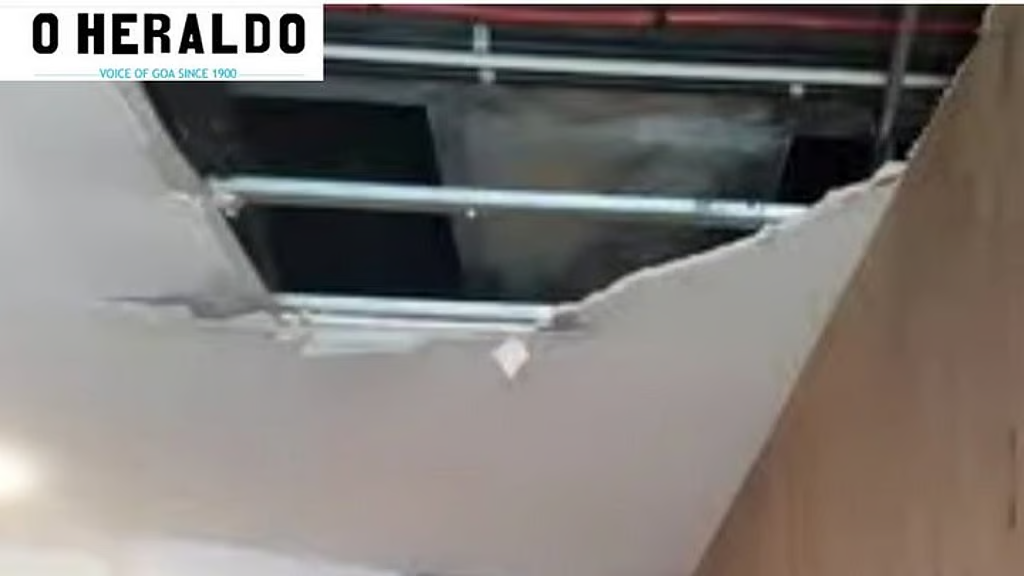
A section of the false ceiling in the Western Music classroom at Kala Academy, Goa, collapsed on July 26, 2025, raising serious concerns about the building’s structural safety. Fortunately, no injuries were reported. The incident occurred without warning, prompting academy officials to immediately cordon off the affected area as a precaution. Structural assessments and safety inspections are currently underway.
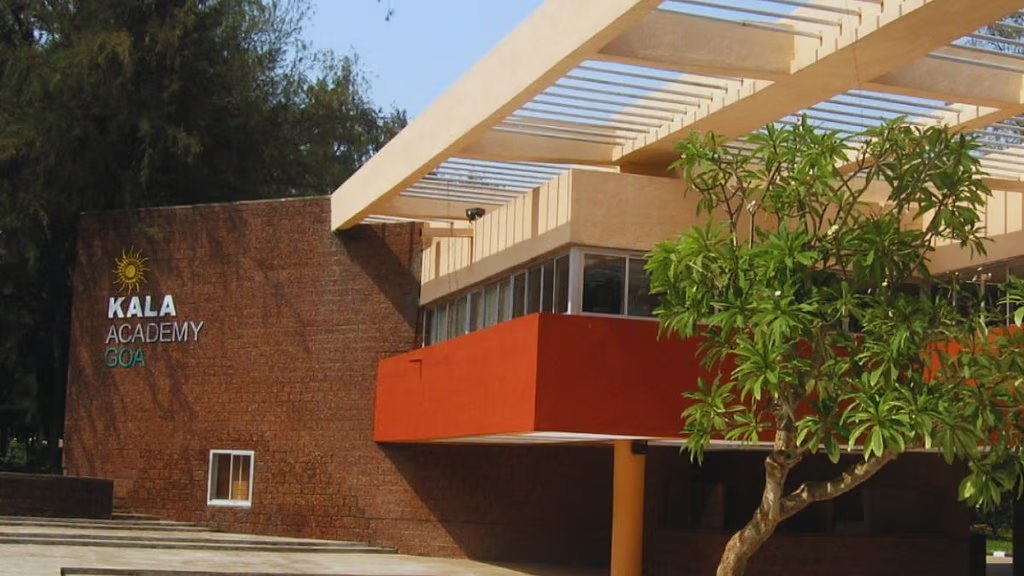
The Kala Academy in Panaji is a beautiful building that finds mention in architectural degree courses across India. It was a must-study building for us as part of the practical training tour at IIT Roorkee. Designed by the eminent Goan architect, the late Charles Correa, it is an iconic building of historical and cultural importance, being the only academy to offer a platform for western music, classical music, dance, drama, tiatr, folk art, photography exhibitions, book release functions, and literary events.
This year’s keynote was delivered by the Australian architect Peter Stutchbury, who is known for his environmentally responsive design philosophy. In his address, Stutchbury paid tribute to Correa’s influence on not just him but many around the world, describing him as a “philosopher of space”.
“It’s an immense honour to deliver the 8th Charles Correa Memorial Lecture in the very city where a part of his extraordinary vision came to life,” said Stutchbury. “Charles Correa was not merely an architect; he was a philosopher of space…”
It’s been 10 years since Charles Correa’s passing in 2015, but his relevance in today’s urban debates has only grown stronger. At a time when Indian cities are buckling under unplanned development and the effects of climate change, Correa’s work and writing offer a counterpoint — one that privileges human-scaled, and environmentally responsive architecture.
Should only artists head institutions like Kala Academy and Ravindra Bhavan? It’s a question that resurfaces every few years in Goa, often sparked by controversy, corruption, or sheer frustration from the artistic community.
Image credits : Scroll.in | The famed architect’s work revealed a deep understanding of space as traditionally built and used in India.
It is ten years since architect Charles Correa passed away on June 16, 2015, at the age of 84.
The day after he died, The Indian Express carried a front page photograph of the Champalimaud Centre for the Unknown, a major medical and research institute in Lisbon. Although this iconic building was designed by Correa, the article was not a recognition of his passing.
Image credits : Shab-Parak, Nagari Short Films 2024
As India’s national capital sleeps, night buses keep the city connected and their commuters find the true meaning of accessible and affordable public transport. Shab-Parak, a short film which won the silver at the Nagari 2024 awards, captures the story of Delhi Transport Corporation’s Bus 0543A from Anand Vihar Inter State Bus Terminal to Kapashera border, its tired but pleasant driver who commands his bus like a community, and its commuters many of whom are at their workplaces as the city awakens.
Image credits : Gomantak Times | ART OF THE MATTER : Goa’s Kala Academy is in they eye of the storm following a controversial remark by Goa’s Art and Culture Minister
‘Supari Andolan’ is a creative protest by Goan artists reclaiming a slur to defend the iconic Kala Academy and preserve Charles Correa’s legacy, demanding accountability, transparency and cultural respect.
The once regal Kala Academy, which has hosted many a celebrity and has been the venue of numerous big-ticket events, including the international Film festival of India, has now been reduced to a joke, or rather, a comedy of (contractual) errors.
Just days after the media reported that Kala Academy was likely to be closed for two whole months for ‘rectification’ work, the state government was slammed for continuing to delay the upgrade of the iconic centre of the arts. But what probably evoked widespread public ire was chief minister Pramod Sawant recently saying that the current contractor will complete repairing the rectifications themselves at no additional cost, in keeping with the Kala Academy’s task force suggestion, and complete the work by October this year, in time for IFFI. “Once that is done, the contract will be terminated and the contractor will be blacklisted,” Sawant is reported to have told the media. If this was not enough to enrage citizens, Sawant went a step further by blatantly declaring that new tenders will be floated for additional works that were not covered in the original contract.
The Goa government has blacklisted contractor Techton Buildcon Pvt Ltd due to renovation flaws at the iconic Kala Academy. Critics, including political opposition and artists, raised concerns about light and sound issues. The government canceled the contractor’s annual maintenance contract and a task force will implement remedial recommendations.
The Goa government has taken decisive action by blacklisting Techton Buildcon Pvt Ltd, the contractor responsible for renovating the iconic Kala Academy. This decision follows persistent flaws in the renovation work, which have drawn widespread criticism from opposition parties and local artists.
Chief Minister Pramod Sawant announced that the contractor has until October to rectify these issues at their own expense. Furthermore, plans for a four-year annual maintenance contract with the contractor have been canceled. The decision came in response to disruptions experienced at the 1,000-seat Deenanath Mangeshkar auditorium, including light and sound problems.
The Goa government on Friday said a contractor had been blacklisted for flaws in the renovation of the iconic Kala Academy building here. Chief Minister Pramod Sawant said contractor Techton Buildcon Pvt Ltd has been given time till October this year to rectify the flaws at its own cost. The government has also cancelled a proposal to sign a four-year annual maintenance contract (AMC) with the contractor, Sawant told reporters. The BJP government in the state had come in for criticism from opposition parties and artistes after glitches were observed in the newly-renovated Kala Academy complex, including light and sound disruptions at the 1000-seater Deenanath Mangeshkar auditorium.
The task force constituted to assess and recommend improvements for the Kala Academy’s infrastructure has submitted its final report to Chief Minister Dr. Pramod Sawant. A meeting with the Public Works Department (PWD) and other relevant authorities to review the findings is scheduled for Friday, May 9, 2025.
Speaking at Mantralaya in Porvorim on Thursday, CM Sawant confirmed the submission. “The Task Force on Kala Academy has submitted its report today. I will hold a meeting on this tomorrow. I haven’t gone through the report yet,” he told reporters.
The task force, chaired by renowned theatre artist Vijai Kenkre, was formed in response to mounting concerns from Goa’s arts community, who criticised the ongoing renovation work at the state’s premier cultural complex as haphazard and unstructured, despite substantial expenditure.
Delegation demands minister’s resignation over recurring technical failures and derogatory remarks
In a scathing attack on the State government, a delegation comprising Congress leaders and artistes visited the Kala Academy on Sunday, questioning the authorities over the recurring technical failures at Goa’s premier cultural institution and calling for the resignation of Art and Culture Minister Govind Gaude.
The delegation also demanded that Minister Gaude publicly apologise to veteran actor Sharad Ponkshe and the wider artistic community for derogatorily labelling Ponkshe a ‘Suparibaaz’ following the disruption of his performance last week due to lighting issues at the Academy.
They further claimed that the renovation of the iconic institution—designed by renowned architect Charles Correa—had tarnished Goa’s reputation in the cultural domain.
Minister Govind Gaude blames ‘technical glitch’, not human error
Even after a Rs 50 crore renovation, the Kala Academy — Goa’s premier cultural venue — is facing basic operational failures, with no one willing to take responsibility. The recent light malfunction during a Marathi play has exposed not only technical flaws but also the absence of accountability among the agencies involved.
Art and Culture Minister Govind Gaude on Thursday termed the incident — where stage lights flickered and halted the performance for 10 minutes — as “unfortunate,” but was quick to dismiss it as a technical fault rather than human error.
Here’s a look at how poor planning and botched renovations have plagued Goa’s premier arts institution for over half a century
February 28, 1970 – Goa govt establishes Kala Academy to promote the arts. The iconic building is designed by renowned architect Charles Correa
2004 – Upgraded to serve as a venue for International Film Festival of India
October 30, 2017 – Minister Govind Gaude announces major facelift for Kala Academy
May 23, 2021 – Techton Buildcon Pvt. Ltd. awarded contract for renovation work. Performances come to a standstill
July 17, 2023 – A large portion of open-air auditorium collapses, raising safety concerns
November 10, 2023 – Building reopens after repairs, but concerns about construction quality persist
April 22, 2024 – Part of newly-renovated false ceiling crashes due to water leakage
May 20, 2024 – Heavy downpour causes auditorium roof to leak during a performance of the Konkani tiatr ‘Girgirem’
July 8, 2024 – Heavy rains inundate Kala Academy
September 27, 2024 – State govt forms task force led by theatre artist Vijai Kenkre to assess state of building and recommend improvements
October 25, 2024 – Charles Correa Foundation withdraws from offering assistance, citing lack of structural audit
April 13, 2025 – Technical failure in stage lighting causes temporary stoppage of a Marathi play starring Sharad Ponkshe, who apologises to audience
The famed Kala Academy has faced several ignominious setbacks, including flooding from a roof collapse during rains and the partial collapse of its open-air auditorium.