An art institution is not merely a building made of bricks and mortar, but a living organism. It is not just a container of creativity, but a space that shapes the way we perceive, engage with and experience art. It holds within itself an atmosphere that is both material and immaterial — packed with potential and meaning.
The once regal Kala Academy, which has hosted many a celebrity and has been the venue of numerous big-ticket events, including the international Film festival of India, has now been reduced to a joke, or rather, a comedy of (contractual) errors.
Just days after the media reported that Kala Academy was likely to be closed for two whole months for ‘rectification’ work, the state government was slammed for continuing to delay the upgrade of the iconic centre of the arts. But what probably evoked widespread public ire was chief minister Pramod Sawant recently saying that the current contractor will complete repairing the rectifications themselves at no additional cost, in keeping with the Kala Academy’s task force suggestion, and complete the work by October this year, in time for IFFI. “Once that is done, the contract will be terminated and the contractor will be blacklisted,” Sawant is reported to have told the media. If this was not enough to enrage citizens, Sawant went a step further by blatantly declaring that new tenders will be floated for additional works that were not covered in the original contract.
The Goa government has blacklisted contractor Techton Buildcon Pvt Ltd due to renovation flaws at the iconic Kala Academy. Critics, including political opposition and artists, raised concerns about light and sound issues. The government canceled the contractor’s annual maintenance contract and a task force will implement remedial recommendations.
The Goa government has taken decisive action by blacklisting Techton Buildcon Pvt Ltd, the contractor responsible for renovating the iconic Kala Academy. This decision follows persistent flaws in the renovation work, which have drawn widespread criticism from opposition parties and local artists.
Chief Minister Pramod Sawant announced that the contractor has until October to rectify these issues at their own expense. Furthermore, plans for a four-year annual maintenance contract with the contractor have been canceled. The decision came in response to disruptions experienced at the 1,000-seat Deenanath Mangeshkar auditorium, including light and sound problems.
The Goa government on Friday said a contractor had been blacklisted for flaws in the renovation of the iconic Kala Academy building here. Chief Minister Pramod Sawant said contractor Techton Buildcon Pvt Ltd has been given time till October this year to rectify the flaws at its own cost. The government has also cancelled a proposal to sign a four-year annual maintenance contract (AMC) with the contractor, Sawant told reporters. The BJP government in the state had come in for criticism from opposition parties and artistes after glitches were observed in the newly-renovated Kala Academy complex, including light and sound disruptions at the 1000-seater Deenanath Mangeshkar auditorium.
The task force constituted to assess and recommend improvements for the Kala Academy’s infrastructure has submitted its final report to Chief Minister Dr. Pramod Sawant. A meeting with the Public Works Department (PWD) and other relevant authorities to review the findings is scheduled for Friday, May 9, 2025.
Speaking at Mantralaya in Porvorim on Thursday, CM Sawant confirmed the submission. “The Task Force on Kala Academy has submitted its report today. I will hold a meeting on this tomorrow. I haven’t gone through the report yet,” he told reporters.
The task force, chaired by renowned theatre artist Vijai Kenkre, was formed in response to mounting concerns from Goa’s arts community, who criticised the ongoing renovation work at the state’s premier cultural complex as haphazard and unstructured, despite substantial expenditure.
Delegation demands minister’s resignation over recurring technical failures and derogatory remarks
In a scathing attack on the State government, a delegation comprising Congress leaders and artistes visited the Kala Academy on Sunday, questioning the authorities over the recurring technical failures at Goa’s premier cultural institution and calling for the resignation of Art and Culture Minister Govind Gaude.
The delegation also demanded that Minister Gaude publicly apologise to veteran actor Sharad Ponkshe and the wider artistic community for derogatorily labelling Ponkshe a ‘Suparibaaz’ following the disruption of his performance last week due to lighting issues at the Academy.
They further claimed that the renovation of the iconic institution—designed by renowned architect Charles Correa—had tarnished Goa’s reputation in the cultural domain.
Minister Govind Gaude blames ‘technical glitch’, not human error
Even after a Rs 50 crore renovation, the Kala Academy — Goa’s premier cultural venue — is facing basic operational failures, with no one willing to take responsibility. The recent light malfunction during a Marathi play has exposed not only technical flaws but also the absence of accountability among the agencies involved.
Art and Culture Minister Govind Gaude on Thursday termed the incident — where stage lights flickered and halted the performance for 10 minutes — as “unfortunate,” but was quick to dismiss it as a technical fault rather than human error.
Here’s a look at how poor planning and botched renovations have plagued Goa’s premier arts institution for over half a century
February 28, 1970 – Goa govt establishes Kala Academy to promote the arts. The iconic building is designed by renowned architect Charles Correa
2004 – Upgraded to serve as a venue for International Film Festival of India
October 30, 2017 – Minister Govind Gaude announces major facelift for Kala Academy
May 23, 2021 – Techton Buildcon Pvt. Ltd. awarded contract for renovation work. Performances come to a standstill
July 17, 2023 – A large portion of open-air auditorium collapses, raising safety concerns
November 10, 2023 – Building reopens after repairs, but concerns about construction quality persist
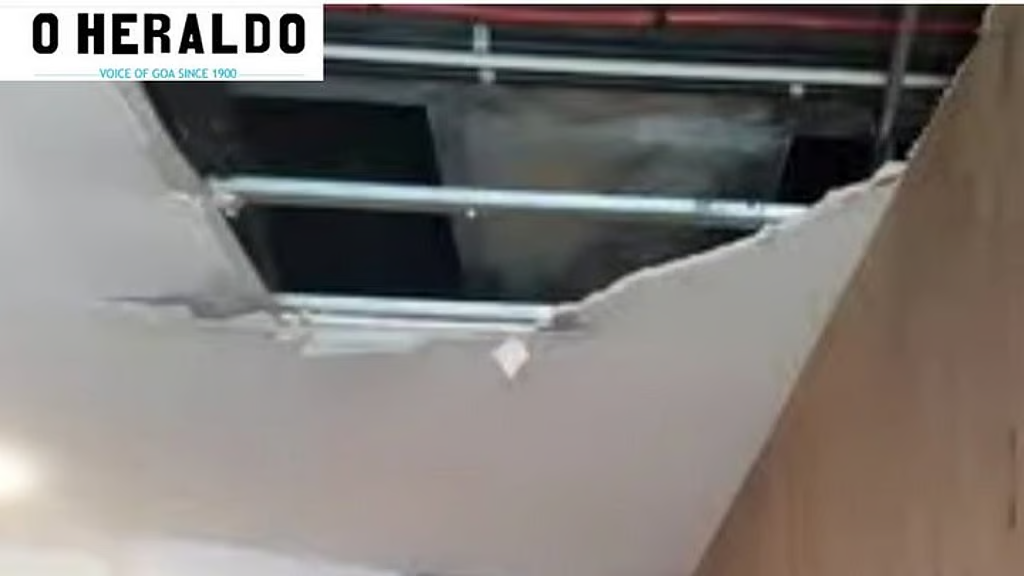
April 22, 2024 – Part of newly-renovated false ceiling crashes due to water leakage
May 20, 2024 – Heavy downpour causes auditorium roof to leak during a performance of the Konkani tiatr ‘Girgirem’
July 8, 2024 – Heavy rains inundate Kala Academy
September 27, 2024 – State govt forms task force led by theatre artist Vijai Kenkre to assess state of building and recommend improvements
October 25, 2024 – Charles Correa Foundation withdraws from offering assistance, citing lack of structural audit
April 13, 2025 – Technical failure in stage lighting causes temporary stoppage of a Marathi play starring Sharad Ponkshe, who apologises to audience
The famed Kala Academy has faced several ignominious setbacks, including flooding from a roof collapse during rains and the partial collapse of its open-air auditorium.
This temporary pavilion, designed and built in 6 months, was the first completed work of the office. Brick and mud walls generate a square plan forming a simple multi-level box, through which visitors move in an easy and continuous flow.
The roof of wood umbrellas, covered with handloom cloth, suffused the internal space with an even light.
This exhibition, organised by the Government of India in 1969 to commemorate the 100th birth anniversary of Mahatma Gandhi, was located directly across the road from the Samadhi at Rajghat where he was cremated.
The complex consisted of four pavilions, each commemorating different aspects of the philosophy and teachings of Gandhiji. Conceived as a series of “non-buildings” party dug into the earth, they were structured by a pedestrian path that moves along a shifting axis, through a series of courtyards.
The brief involved preparing the overall concept and Master Plan for the four pavilions, and detailed architectural drawings for two of them.
This museum, an entry in an international competition, is a recall of the Hindustan Lever Pavilion (Delhi, 1961). The epic struggle for Human Rights generates the architectural form-not only in the exterior massing, but also in the powerful and primordial spaces that lie within. Beyond the Great Hall, are located the 4 Theme Pavilions, grouped around the Garden of Contemplation, in a manner which allows visitors to experience these pavilions in the order they prefer.
As one goes though the exhibits, the floor levels of the pavilions are successively raised, symbolizing the gradual ascent of humankind through the centuries. The final release comes at the highest level, as one enters the Garden of Contemplation, with the daylight streaming through the glass roof above-bringing with it the crucial element of hope, so essential to the journey.
The form of these Memorial Gates serves to conjure up the diverse and pluralistic cultures they celebrate. For the deep-structure that underlines their gesture finds resonance in almost every culture: viz., the doorway, or darwaza – a portal signifying entrance and journey. Wonderfully expressive, it allows subtle allusions to the many diverse cultures embodied in these gates.
Thus the circular convex mirror in the center not only serves to anchor the whole composition , but could also be a metaphor for bindu (i.e., the mythical source of all Energy that lies at the heart of Buddhism and Hinduism).
So also the sweeping gesture next to it, reaching out into the sky, seems to evoke the desert landscape and crescent moon of Islam.- and the scattered holes, the islands of the Caribbean.
This Museum of Islamic Art was the winning entry, in a competition involving eight international architects and a jury of Ricardo Legoretta, Fumihiko Maki, Luis Monreal among others
The design is generated by two basic themes: the wall and the courtyard.. This polished red granite wall, mirroring the sea and the sky along the Corniche, modulates in thickness and height along its length. The resulting curve serve both form and function, accommodating various service spaces used by the galleries such as cargo elevators and access to storage facilities. The galleries are flexible, and the pathways offer several alternative routes for visitors to view the exhibition areas in a variety of sequences, all structured by the centrality of the sunken courtyard with the inlaid char bagh.
The wall, climaxing in a recall of the original astronomical instruments developed by Ulugh Bey in Central Asia, pays tribute to the achievements of Islam in science and astronomy, and serves as a platform for visitors to view in the city of Doha.
Maharaja Jai Singh, who built the fabled pink city of Jaipur, was moved by two seemingly conflicting sets of mythic ideas and images. On the one hand there was the ancient Navgraha (the mandala of the nine planets)-and on the other, the newest myths of Science and Progress (e.g., the Jantar Mantar, the astronomical Instruments he constructed to measure, with the greatest possible scientific accuracy, the movement of sun and stars across the skies).
Thus the city of Jaipur, double coded like Jai Singh himself, is truly astonishing for its synthesis of past and future, of the material and metaphysical words. In this, Jai Singh is indeed analogous to another man, born more than two centuries later,, India’s first Prime Minister Jawaharlal Nehru. Guiding the nation after Independence, Nehru wanted to re-discover India’s past whilst simultaneously opening the door to a new future.
Thus this Arts Centre, dedicated to Nehru, is really a metaphor for both men- and for Jaipur itself. Like them and like the city, it is double-coded: a contemporary building based on an archaic notion of the Cosmos:- the very same Navgraha mandala, with one of the squares moved aside , to recall the gesture that created the original plan for Jaipur.
The site for this Art Centre is on a gently sloping hill overlooking the lake in Bhopal. The natural contours of the site have been used to create a series of terraced gardens and sunken courtyards-off which are located a number of cultural facilities, including a museum of Tribal Art, a library of Indian poetry (in all the 17 major languages), galleries for Contemporary Art, workshops for lithography and sculpture, and a studio for an artist-in-residence. Bharat Bhavan also houses a full-fledged theatrical repertoire company and facilities for the performing arts, including the Antarang (indoor auditorium), and the Bhairang (open-air amphitheater), overlooking the lake.
Lighting and ventilation within the building are provided by top lights (from the concrete shells and from slots along the terrace parapets). The openings to the courtyards and terraces have two sets of shutters: the inner ones consisting of a combination of fixed glass and operable panels for light and ventilation; the outer ones consisting of large wooden doors, closed at night for security.
This Crafts Museum, casual and accepting of the artisan’s vernacular, is organized around a central pathway, going from village to temple to palace, a metaphor for the Indian street- in fact, for India herself, where all these different kinds of crafts have always co-existed down the centuries. Walking along this spine, one catches glimpses of the principal exhibits that lie on either side (the Village Court, Darbar Court, etc). One can visit any particular exhibit, or alternately, progress through all the various sections in a continuous sequence.
Towards the end of the sequence, the exhibits gets larger and include fragments of actual buildings-since the crafts of India have always been an essential element of her architecture, Finally, one exists via the roof terraces which form an amphitheater for folk dances, as well as an open-air display for large terracotta horses and other handicrafts.
Less than half of the total floor area of 5500 sq.m is open to the public; the rest of the collection is stored in special areas for the use of the very finest craftsmen who are selected from all over India to come and study these archives. In this manner, a potter from Bengal has the opportunity to examine at first hand the best work of his counterparts in Kerala, at the other end of the country- or for that matter, what his own forebears in Bengal had produced two or three hundred years previously. This is a perspective which has hitherto never been available to traditional Indian craftsmen.
This project is a further development of the themes of the Handloom and Hindustan Lever Pavilions. Here the maze is extended to cover the roof – surfaces as well – so that one enters and goes into, through, and over and out of a large puzzle-box.
The architectural form is deliberately low-key, a “non-building” given scale principally by the flights of stairs (echoing the bathing ghats of the rivers of India) and the effigy of the mythological demon Ravana.
Built for the Gandhi Smarak Nidhi, Kasturba, the wife of Mahatma Gandhi, was under house arrest in Poona when she died in 1944. This memorial was built on the spot where she was cremated.
Located on the edge of the Agha Khan Gardens, the memorial consists of a gently descending path along a shifting axis, open-to-sky, defined by a series of parallel brick walls, culminating in the Samadhi itself.
At several points along the path there are ramps up to levels from which the surrounding landscape is viewed. The podium created by these terraces houses a modest museum devoted to Kasturba.
The industrial fairs held annually in Delhi provided an extraordinary opportunity for architects to experiment..
This is a variation of the earlier Handloom Pavilion.
The circulation pattern is similar, but the forma has metamorphosed due to the long narrow site, and because of the structural system used: random-folded RCC plates, united in-situ, encasing ramps and platforms below-and creating huge ‘’cannons’’ which set up convection currents of air through the fractured, scaleless spaces.
This memorial is erected in the Sabarmati Ashram where Mahatma Gandhi resided from 1917 to 1930, and from which the started on this historic Salt March to Dandi. Built in homage to the Mahatma, and to propagate his ideas, it houses letters, photographs and other documents which trace the freedom movement launched by Gandhiji.
The materials used in the construction are similar to the other buildings in the ashram: tiled roofs, brick walls, stone floors and wooden doors. The only additions are the RCC channels which act as beams and as rainfall conduits – and which permit additional construction to be added in the future. No glass windows are used anywhere un the building; light and ventilation being provided by openable wooden louvres.
These elements combine to form a pattern of tiled roofs, in a typology analogous to the villages so central to Gandhiji’s thinking. They are grouped in a casual meandering pattern, creating a pathway along which the visitor progresses towards the centrality of the water court.